

 English
 русский
 Español
 Deutsch
 عربى
عربى Français
 Português
Don't hesitate to send a message

Single jacket, EPDM rubber liner Features • 100% high tenacity polyester jacket, high-grade EPDM rub...
Content
In modern fire protection systems, a fire cabinet is more than a simple metal box on a wall. It is a dedicated storage point for fire hose, valves, nozzles, couplings, hose reels, and related firefighting accessories that must remain visible, accessible, protected, and ready for use. A 201 stainless steel fire cabinet offers a practical balance of durability, clean appearance, corrosion resistance, customization, and cost efficiency, making it suitable for commercial buildings, factories, warehouses, public facilities, residential complexes, and industrial sites where dependable emergency equipment storage is required.
The 201 stainless steel fire cabinet described in this article is designed to accommodate fire hose, valves, and other firefighting equipment in a well-organized enclosure. It is available in surface wall mounted, recessed, and semi-recessed models, allowing building designers, contractors, and fire safety system integrators to select the most suitable installation style according to wall structure, space limitations, visibility requirements, and project standards. With a stainless steel door and frame, optional clear tempered glass, several locking choices, and customizable dimensions and lettering, the cabinet can be adapted to a broad range of fire protection layouts.
Compared with ordinary painted steel cabinets, lower-grade sheet metal enclosures, and poorly finished imported alternatives, a well-manufactured 201 stainless steel fire cabinet provides stronger resistance to daily wear, better visual quality, easier cleaning, and improved long-term value. For projects that require neat appearance as well as functional reliability, stainless steel construction helps reduce the risk of premature rusting, peeling paint, deformation, and unattractive surface deterioration. This is especially important in hotels, office buildings, hospitals, schools, transportation hubs, shopping centers, and industrial workshops where fire safety equipment must remain presentable and usable over many years.
Taizhou Shenlong Fire Science and Technology Co., Ltd. has developed its manufacturing experience since 1995 and has built a product system centered on fire hoses, hose-related accessories, and fire equipment storage solutions. The company combines research and development, production, sales, and service, with products widely used in fire protection, construction, water conservancy, and other industries. Its experience in fire hose production, hose couplings, hose nozzles, fire accessories, and cabinets gives it a practical understanding of how storage cabinets must function together with real firefighting equipment, rather than being treated as isolated sheet metal products.
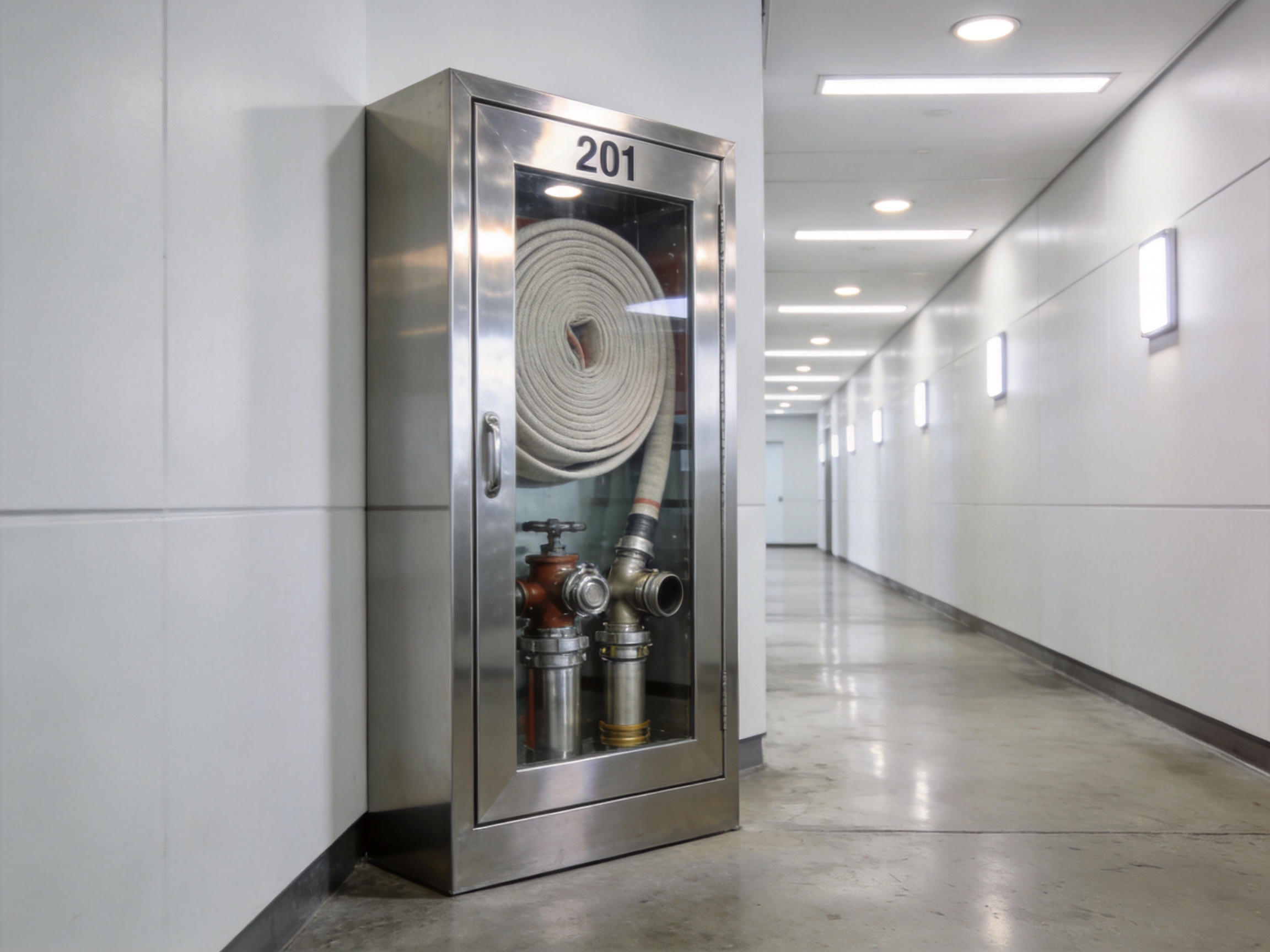
A 201 stainless steel fire cabinet is built to protect and organize emergency equipment so that trained personnel or building occupants can quickly locate and deploy fire hose and related components when needed. In an emergency, time matters. A cabinet that is clearly visible, easy to open, properly sized, and designed with suitable internal capacity can help reduce confusion and support faster response. The cabinet also prevents hoses, valves, nozzles, and couplings from being scattered, contaminated, physically damaged, or hidden behind other objects.
The cabinet uses Type 201 stainless steel for the door and frame. Surface mounted models are designed with rolled edge trim and stainless steel tubs with a galvanized back panel. Recessed models use a recessed flange and a tub constructed of cold rolled steel with a red powder-coated finish. This combination of materials is intended to match the installation environment while balancing appearance, strength, and manufacturing economy. The customer may select a solid door or a door with clear tempered glass, and the cabinet may be fitted with a press-button or rotary lock depending on project requirements.
The main available installation styles include surface wall mounted cabinets, recessed cabinets, and semi-recessed cabinets. A surface wall mounted cabinet is typically easier to install on existing walls and is suitable for retrofit projects where cutting into the wall is not practical. A recessed cabinet creates a cleaner architectural appearance by setting the tub into the wall cavity. A semi-recessed cabinet provides a compromise between these two approaches, reducing protrusion while avoiding the deeper wall requirements of a fully recessed design.
The available sizes listed for common hose capacities include cabinets for 1.5 inch by 30 meter hose and 2.5 inch by 30 meter hose. The stated standard dimensions can serve as a baseline, while actual dimensions may be produced according to customer request. This flexibility is important because fire protection projects are rarely identical. Different countries, local fire codes, hose diameters, valve types, nozzle sizes, signage styles, and wall depths may require adjusted dimensions. A manufacturer with customization capability can help avoid the common problem of cabinets that are attractive but too small, or oversized cabinets that waste space and increase project cost.
Feature |
Available Option or Specification |
Practical Benefit |
Installation Type |
Surface mounted, recessed, semi-recessed |
Fits new construction, renovation, and limited-space projects |
Frame Material |
Mild steel or Type 201 stainless steel |
Provides choice between economy and enhanced surface durability |
Door Type |
Solid door or clear tempered glass door |
Supports visual inspection and architectural preferences |
Window |
Full clear tempered glass |
Allows quick confirmation of hose and equipment presence |
Door Lock |
Press-button lock or rotary lock |
Improves access control while keeping emergency access simple |
Common Capacity |
1.5 inch by 30 m hose or 2.5 inch by 30 m hose |
Matches common firefighting hose arrangements |
Customization |
Dimensions and lettering on request |
Meets project, language, branding, and code requirements |
Stainless steel is widely valued for its clean surface, resistance to oxidation, and ability to maintain an attractive appearance under normal indoor conditions. Type 201 stainless steel is often selected when customers want a stainless appearance and improved corrosion resistance compared with basic carbon steel, while also controlling cost compared with higher nickel stainless grades. For many interior fire cabinet installations, 201 stainless steel provides a strong balance between performance and affordability.
In comparison with low-cost painted mild steel cabinets, the 201 stainless steel cabinet has a more premium visual effect and is less likely to show surface defects caused by scratches, paint peeling, or improper coating adhesion. Painted steel can perform well when coating quality is high, but it may deteriorate faster if the surface is damaged during transport, installation, or daily use. Once the paint layer is broken, moisture can attack the steel underneath. Stainless steel reduces this vulnerability because its surface protection is inherent to the material rather than dependent only on an applied coating.
Compared with plastic or thin aluminum cabinets, a stainless steel cabinet offers stronger rigidity and improved resistance to impact. Fire protection equipment may be located in corridors, warehouses, loading areas, underground parking facilities, and public buildings where accidental bumps are common. A weak cabinet door can warp, jam, crack, or lose alignment, making emergency access difficult. Properly formed stainless steel frames and doors help maintain stable geometry and consistent closing performance.
Some competitors focus mainly on producing the lowest possible price by using thinner sheet metal, rough edges, inconsistent welding, weak hinges, or poor packaging. These shortcuts may reduce initial cost but can lead to installation problems, sharp exposed edges, damaged doors, uneven gaps, loose locks, and complaints from project owners. A carefully manufactured cabinet, by contrast, is designed not only to pass visual inspection on delivery but also to serve through years of daily building operation.
The first major advantage is structural reliability. A fire cabinet must hold the weight and shape of hose and accessories without sagging or distortion. Fire hose is not a decorative item; it may be heavy, especially when paired with valves, nozzles, and couplings. The cabinet frame, tub, door, hinges, and lock must work together as one assembly. Rolled edges, formed flanges, and properly fitted parts increase stiffness and reduce the risk of deformation. This advantage becomes more obvious after installation, when cabinet doors are repeatedly opened, cleaned, inspected, and sometimes handled roughly.
The second advantage is better appearance over the service life. Fire cabinets are often installed in highly visible locations because emergency equipment must be easy to find. In hotels, office buildings, hospitals, schools, and commercial centers, unattractive cabinets can negatively affect the interior appearance. Type 201 stainless steel provides a clean and professional look that suits modern buildings. When combined with tempered glass windows and customized lettering, the cabinet can satisfy safety requirements while also integrating with architectural design.
The third advantage is practical maintenance. Stainless steel surfaces are generally easy to wipe clean and do not require frequent repainting under normal conditions. Dust, fingerprints, and minor dirt can be removed with appropriate cleaning methods. In busy facilities, maintenance teams prefer equipment that remains presentable with simple routine care. A cabinet that quickly rusts or loses paint may require extra maintenance, replacement panels, or premature full replacement, increasing ownership cost.
The fourth advantage is flexibility. Surface mounted, recessed, and semi-recessed models cover different installation situations. A surface wall mounted cabinet is useful where construction is complete or wall cavities cannot be modified. A recessed model provides a flush, professional finish in new building projects. A semi-recessed option is valuable when the wall cannot accommodate the full cabinet depth but the designer wants to minimize protrusion into the corridor. Many low-end suppliers only offer limited model choices, forcing customers to compromise. Flexible cabinet design helps contractors complete projects more efficiently.
The fifth advantage is customization. The cabinet dimensions and lettering can be produced according to customer request. This is essential for export markets and engineering projects because regulations, language requirements, hose sizes, and installation details vary. Lettering may need to identify the contents, such as fire hose, hose reel, fire valve, or other firefighting equipment. A supplier with customization capability can support distributors, contractors, and project buyers who need consistent cabinets across multiple buildings while still meeting local requirements.
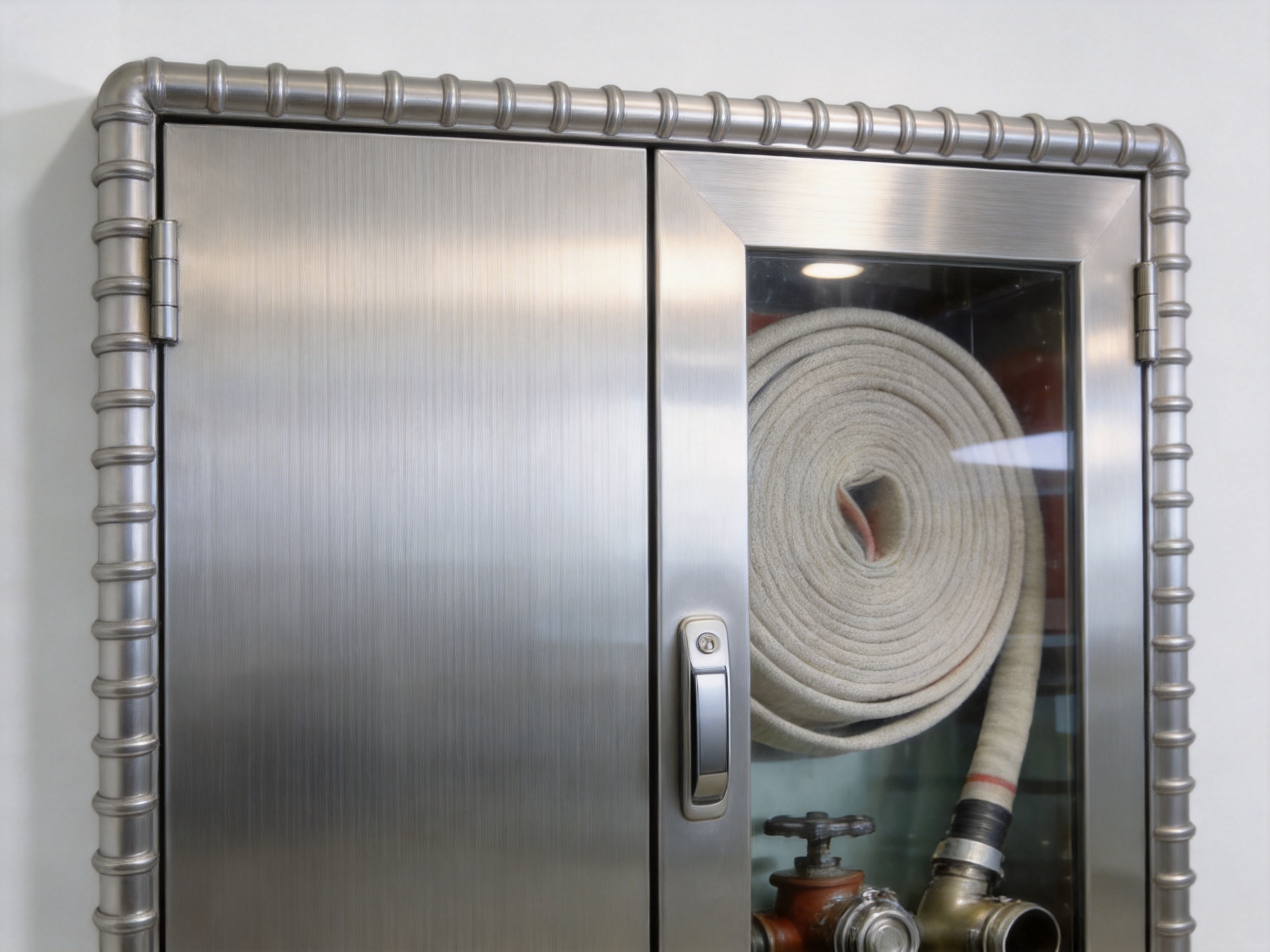
A fire cabinet must be designed for both emergency access and long-term storage. The door should open smoothly, remain aligned, and close securely. The lock should protect the contents from casual tampering while still allowing quick access when necessary. The window, if supplied, should provide clear visibility and resist breakage better than ordinary glass. The cabinet body should have enough depth, width, and height to accommodate the specified hose arrangement without forcing the hose into an unnatural position.
The use of clear tempered glass is an important detail. Tempered glass improves safety compared with ordinary glass because it is treated to increase strength and, if broken, tends to break into smaller, less dangerous pieces rather than large sharp shards. A glass door or window allows inspectors to confirm that the hose, nozzle, and valve are present without opening the cabinet each time. This can save time during routine inspections and helps building managers notice missing equipment more quickly.
Door choice is another important consideration. A solid door may be preferred in areas where a cleaner appearance, better concealment of internal equipment, or stronger visual uniformity is required. A clear tempered glass door may be preferred where rapid inspection and immediate recognition are priorities. Both options have value, and the correct selection depends on the project environment. The ability to supply both styles gives the manufacturer a competitive advantage over suppliers with only one fixed configuration.
Lock options such as press-button and rotary designs allow the cabinet to match local user expectations and safety policies. In some buildings, easy press-button access may be suitable. In other locations, rotary locks may be preferred for more controlled opening. The goal is not to create unnecessary barriers during an emergency, but to protect equipment from misuse, theft, dust exposure, or accidental opening. Good cabinet design considers this balance carefully.
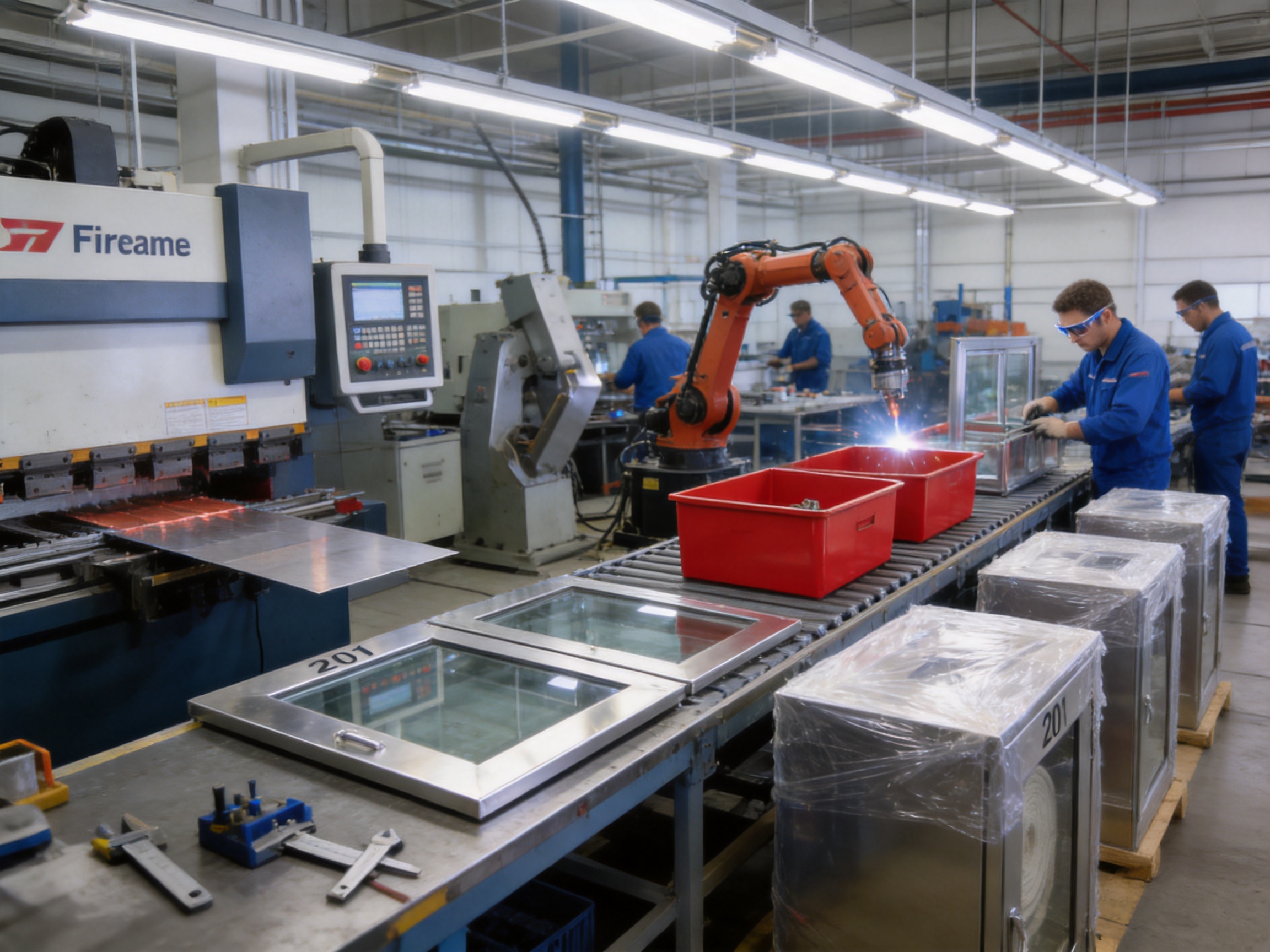
Advanced manufacturing of stainless steel fire cabinets begins with material selection. Suitable sheet material must be chosen according to thickness, surface condition, flatness, and intended cabinet style. Incoming material inspection is important because visible scratches, inconsistent thickness, or poor surface finish can affect the final product. A manufacturer with experience in firefighting equipment understands that appearance and function both matter, especially because fire cabinets are often installed in prominent indoor positions.
After material selection, sheet cutting must be accurate. Modern cutting equipment helps create panels, frames, doors, and backing components with consistent dimensions. Accurate cutting reduces the need for excessive correction during assembly and improves door alignment. Inconsistent cutting can cause uneven gaps, poor fit, and unstable cabinet geometry. Precision at this early stage directly affects the quality of the final cabinet.
Bending and forming are equally important. Rolled edge trim, recessed flanges, door returns, and tub shapes must be formed with controlled angles and clean lines. Good forming increases cabinet strength and removes sharp edges that could injure installers or users. Poorly formed cabinets may look acceptable from a distance but reveal problems during installation, such as twisting, inaccurate mounting surfaces, or doors that do not sit flat.
Welding and joining processes must be controlled to avoid excessive distortion, weak connections, or visible defects. Stainless steel can deform if heat input is poorly managed. Skilled operators and appropriate procedures help maintain structural integrity while preserving the cabinet’s appearance. For fire cabinet production, consistency is critical because contractors often install multiple units in one building. If every unit varies in dimension or door fit, installation becomes slower and more expensive.
Surface finishing is another area where manufacturing strength becomes visible. Stainless steel doors and frames require careful handling to prevent avoidable scratches and dents. Where powder-coated cold rolled steel tubs are used, surface preparation, coating application, and curing must be controlled to obtain a uniform red finish with good adhesion. Powder coating provides a protective and visually clear interior or tub surface, and the red color is widely associated with fire equipment, helping users identify the cabinet’s function.
Assembly includes installation of hinges, glass, locks, frames, and any required internal fittings. Each part must align correctly. A door that rubs, rattles, or closes unevenly creates a poor impression and may reduce emergency reliability. The glass must be seated securely, and locking mechanisms must operate smoothly. Repeated function checks are valuable because a cabinet may look complete but still fail to provide the smooth access needed in the field.
Final inspection should include dimensional verification, visual surface inspection, lock operation, door opening and closing tests, glass inspection, packaging review, and confirmation against customer specifications. Custom dimensions and lettering require special attention because errors may not be discovered until the cabinet reaches the construction site. A disciplined inspection system helps prevent costly delays, especially for export orders and large projects.
Packaging is often underestimated, but it is a major part of product quality. Stainless steel cabinets can be damaged by impact, vibration, moisture, or careless handling during transport. Protective packaging helps preserve edges, glass, corners, and surface finish. For international shipments, packaging must consider longer transport distances and multiple handling stages. A manufacturer experienced in export production understands that product quality is not complete until the cabinet arrives at the customer’s site in usable condition.
Taizhou Shenlong Fire Science and Technology Co., Ltd. was founded in 1995 and has developed into an enterprise integrating research and development, production, sales, and service. The company’s main products include various material-lined fire hoses, while its broader product categories include fire hose, industrial hose, agricultural hose, hose couplings, hose nozzles, fire accessories, fire cabinets, and trenchless rehabilitation hose. This product range gives the company a strong understanding of hose storage, connection compatibility, and fire protection application environments.
Many cabinet suppliers are general metal fabrication workshops with limited knowledge of firefighting equipment. They may produce a box with a door but may not fully understand hose capacity, coupling clearance, nozzle placement, valve access, or inspection needs. A manufacturer active in hose and fire accessory production can design cabinets around actual emergency equipment. This integrated knowledge is one of the company’s competitive strengths.
The company can also undertake various foreign trade products according to customer requirements, including rubber, PVC, polyurethane, and double-sided tape products. This ability reflects flexible production management and export cooperation experience. Its products have been sold in more than twenty provinces, cities, and autonomous regions, and export products have been produced in cooperation with domestic foreign trade companies for many countries. Such experience supports better communication with different market requirements, packaging expectations, and documentation practices.
Because the company serves fire protection, construction, water conservancy, and related industries, it understands that equipment must perform reliably in practical use rather than only look correct in catalogs. Fire cabinets must match site installation conditions, hose size, user access habits, and building safety management. This practical orientation helps customers reduce mismatch risk and obtain cabinets that can function properly within complete fire safety systems.
201 stainless steel fire cabinets are suitable for a wide range of indoor and protected environments. In commercial buildings, they provide organized fire hose storage in corridors, stairwells, equipment rooms, and public service areas. The stainless steel appearance can coordinate with modern interior finishes while still clearly identifying the location of firefighting equipment. Where glass doors are used, facility managers can quickly inspect the cabinet contents.
In factories and warehouses, fire cabinets help protect hoses and nozzles from dust, accidental movement, and mechanical damage. Industrial environments often contain forklifts, carts, pallets, tools, and equipment that can obstruct or damage exposed fire equipment. A properly mounted cabinet creates a designated protective location and helps maintain compliance with internal safety procedures. Stainless steel construction also helps the cabinet withstand frequent cleaning and handling.
In residential complexes and apartment buildings, cabinets provide accessible fire equipment for common areas. The cabinet should be visible enough for emergency response but secure enough to discourage tampering. A neat cabinet also improves the appearance of shared corridors and lobbies. Customized lettering can help residents identify the cabinet quickly, while the selected lock type can reflect local fire safety requirements.
In schools, hospitals, and public institutions, the cabinet must support both safety and orderly management. Fire equipment may be inspected regularly, and the cabinet must remain safe around large numbers of people. Smooth edges, reliable doors, and tempered glass are useful in these environments. A cabinet that is damaged, rusted, or difficult to open can create unnecessary risk in places where occupant safety is especially important.
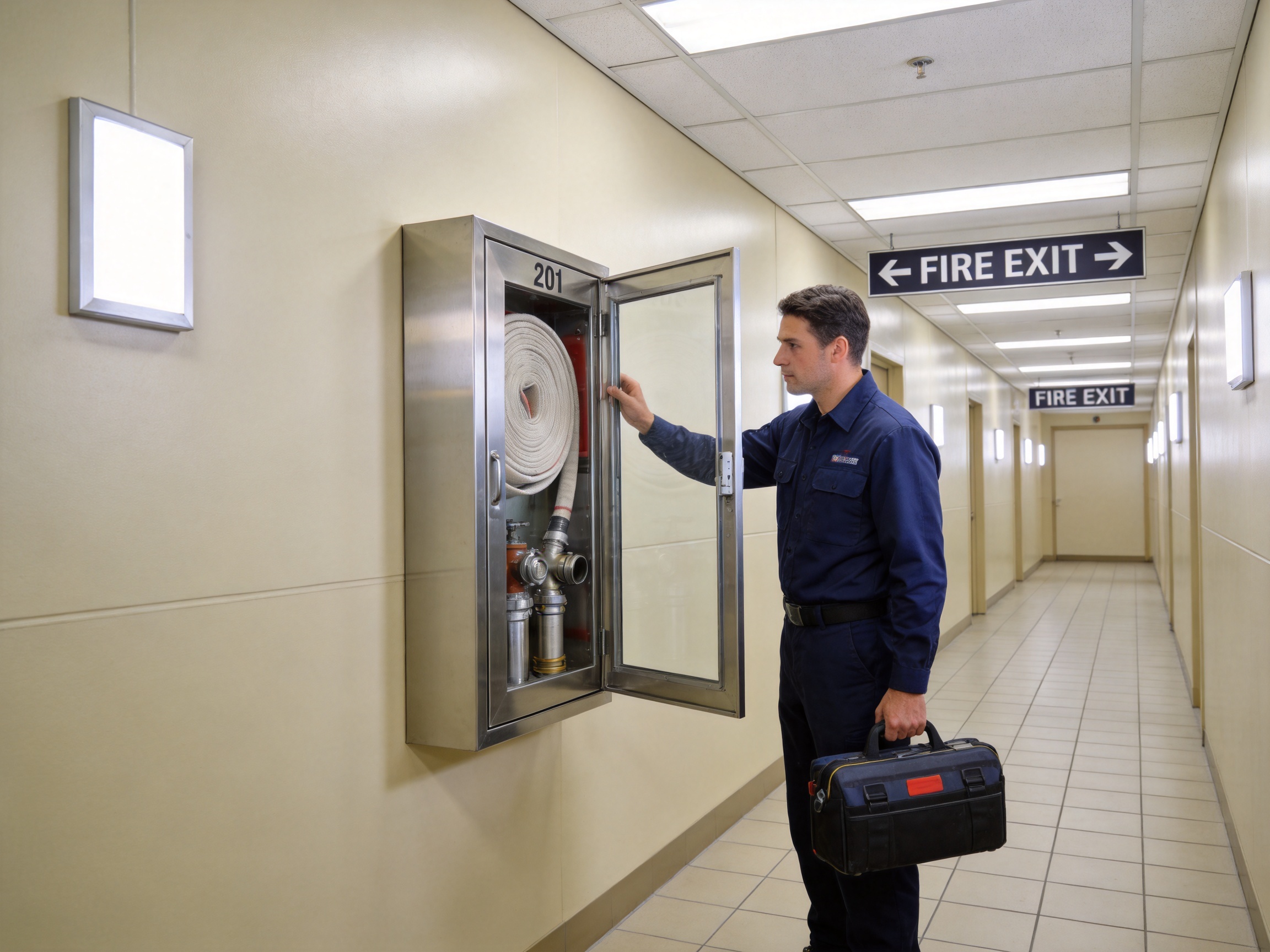
Proper installation is essential for performance. Even a well-made cabinet can perform poorly if it is mounted unevenly, installed at an unsuitable height, or placed in an obstructed location. The cabinet should be positioned according to applicable fire protection plans and local regulations. It should be visible, reachable, and free from permanent obstacles. If the cabinet contains hose connected to a valve, the valve position and hose path must be considered before installation.
For surface wall mounted cabinets, the wall structure must be strong enough to support the cabinet and its contents. Mounting points should be aligned, and fasteners should be selected according to wall material. Uneven mounting can twist the cabinet and cause door misalignment. Installers should check the door operation after tightening fasteners, because excessive force or uneven support can affect the frame.
For recessed cabinets, wall openings must be prepared accurately. The cabinet depth, flange dimensions, and surrounding finish must be coordinated before installation. If the opening is too small, the cabinet may be forced into place and deformed. If the opening is too large, the finished appearance may be poor, and additional repair work may be needed. Recessed installation should also consider building services behind the wall, including electrical conduits, pipes, and structural elements.
For semi-recessed cabinets, the installer must balance wall cavity depth with the amount of cabinet projection. This type is useful when the wall cannot accept a fully recessed cabinet, but the project still wants reduced protrusion. Accurate measurement is important because semi-recessed cabinets must align well with both the wall surface and internal cavity. The flange should sit neatly to produce a professional finish.
After installation, the cabinet should be inspected for door swing, lock operation, glass security, internal equipment placement, and visibility of lettering. The hose should fit without excessive compression, and accessories should be arranged so they can be removed quickly. If the cabinet is used for a hose reel, the reel operation should also be tested. Emergency equipment storage should never be treated as complete until practical access has been confirmed.
Routine maintenance helps preserve the value of a 201 stainless steel fire cabinet. Facility managers should include fire cabinets in scheduled fire safety inspections. The inspection should confirm that the cabinet is not blocked, damaged, locked incorrectly, or missing contents. The door should open smoothly, the lock should function, and the glass should be intact. The hose, valve, nozzle, and couplings should be checked according to the relevant fire safety maintenance program.
Cleaning should be performed with suitable materials. Stainless steel surfaces should be wiped with soft cloths and mild cleaners. Strong abrasive tools can scratch the surface, while harsh chemicals may damage the finish or leave stains. In public buildings, fingerprints and dust are common, but they can normally be removed with regular cleaning. Keeping the cabinet clean improves appearance and encourages respect for fire safety equipment.
If the cabinet is installed in a damp, coastal, chemical, or otherwise aggressive environment, additional care may be required. Although Type 201 stainless steel offers useful corrosion resistance, environmental conditions vary. Regular wiping, prompt removal of contaminants, and avoiding contact with corrosive chemicals can extend service life. If severe corrosion exposure is expected, customers should discuss material and finish requirements with the manufacturer before ordering.
Locks, hinges, and moving components should be checked periodically. A lock that becomes stiff or a hinge that begins to bind may delay access. Simple preventive maintenance can avoid larger problems later. If a glass panel is cracked, it should be replaced promptly. If the cabinet body is dented by impact, the door alignment and internal clearance should be inspected to ensure equipment can still be accessed quickly.
Customization is a major reason buyers choose a professional fire cabinet manufacturer rather than a standard commodity supplier. The dimensions can be produced according to customer request, allowing the cabinet to fit specific hose sizes, valve arrangements, architectural requirements, and export market standards. A contractor working on a large building may need consistent cabinet appearance across floors while also adjusting depth or internal layout for different locations.
Lettering can also be customized. This may include simple fire equipment labels, local language requirements, project-specific identification, or safety markings. Clear lettering helps users recognize the cabinet quickly in an emergency. It also helps inspectors and maintenance teams identify cabinet contents. In export markets, correct lettering can be essential for acceptance by the customer or local authority.
Door and window options offer additional design flexibility. Some projects prefer full clear tempered glass to maximize visibility. Others prefer partial windows or solid doors for a cleaner appearance. The cabinet may be designed for the storage of hose alone, hose plus valve, hose reel assemblies, or other firefighting accessories. Early communication between buyer and manufacturer helps ensure that the final cabinet supports actual equipment layout.
The ability to supply related products such as fire hose, hose couplings, hose nozzles, and fire accessories can simplify procurement. Buyers may prefer to source compatible equipment from one experienced supplier rather than coordinate multiple vendors. This can reduce communication errors, improve packing efficiency, and support consistent quality expectations across the fire protection package.
For distributors, the 201 stainless steel fire cabinet is a practical product because it serves a wide range of building and industrial needs. Its stainless steel appearance makes it easier to present as a value-added alternative to basic painted cabinets. The availability of different installation styles and customized dimensions helps distributors respond to diverse customer inquiries. A reliable manufacturer also supports repeat orders, stable quality, and fewer after-sales problems.
For contractors, cabinet consistency is especially important. Construction schedules are often tight, and a cabinet that arrives with poor dimensions, damaged corners, or misaligned doors can delay installation. A professionally manufactured cabinet reduces rework and helps contractors pass project inspection more smoothly. Customization also helps contractors match site drawings and avoid field modifications that consume time and labor.
For building owners and facility managers, the long-term benefit lies in reduced maintenance concerns and improved emergency readiness. A cabinet that remains clean, functional, and visible over time supports better safety culture. When occupants see fire equipment stored properly, they are more likely to understand that emergency systems are maintained seriously. This can contribute to better overall facility management.
For fire safety consultants and system designers, the cabinet provides a flexible specification item. The designer can select surface, recessed, or semi-recessed installation, choose door and lock options, and request dimensions based on the fire hose and accessory layout. This flexibility supports better integration with the building design and fire protection strategy.
The first selection factor is hose size and equipment capacity. A cabinet intended for 1.5 inch by 30 meter hose may not be suitable for larger hose and accessories. Buyers should confirm the hose diameter, hose length, coupling size, nozzle type, valve arrangement, and whether additional equipment will be stored in the same cabinet. Allowing adequate internal space helps avoid difficult removal during an emergency.
The second factor is installation method. Surface mounted cabinets are usually simpler for existing buildings. Recessed cabinets are best planned during new construction or major renovation. Semi-recessed cabinets are useful where wall depth is limited but reduced projection is desired. The project team should confirm wall structure, opening size, corridor clearance, and accessibility before ordering.
The third factor is the environment. For clean indoor areas, 201 stainless steel is an attractive and economical option. For harsher chemical or outdoor exposure, the customer should review environmental conditions with the supplier. The correct cabinet choice depends not only on material but also on installation location, maintenance practice, and expected service conditions.
The fourth factor is inspection preference. If regular visual confirmation is important, a clear tempered glass door or window is beneficial. If a more uniform appearance is desired, a solid door may be preferred. The decision should consider both safety management and architectural design. In many projects, glass doors are used in technical areas, while solid doors may be selected for premium public interiors.
The fifth factor is compliance and labeling. Customers should check local fire safety requirements related to cabinet color, size, labeling, access method, and mounting height. Because lettering is available on request, the cabinet can be adapted to the requirements of different regions. Clear communication before production helps avoid compliance issues after delivery.
When procurement teams compare fire cabinets, they often focus on price first. However, the lowest price does not always represent the lowest total cost. A cabinet with thin metal, poor packaging, weak hinges, or inaccurate dimensions may create costs through damage claims, installation delays, replacement, and customer dissatisfaction. A better approach is to evaluate material, manufacturing quality, customization capability, packaging, and supplier experience together.
The 201 stainless steel fire cabinet provides a competitive balance because it offers a stainless appearance and practical durability without the higher cost of premium stainless grades that may not be necessary for many indoor projects. This makes it attractive for customers who need reliable equipment storage in quantity but still want a professional finish. The cabinet can serve mid-range and high-value projects where ordinary painted cabinets may appear too basic.
The company’s background in fire hose and related fire protection products adds another competitive layer. Instead of manufacturing cabinets as isolated metal furniture, it can consider the real dimensions and handling needs of hose, couplings, nozzles, and valves. This industry-specific knowledge helps produce cabinets that are more suitable for actual firefighting equipment storage.
Manufacturing discipline also creates value. Accurate cutting, forming, welding, finishing, assembly, inspection, and packaging all contribute to final product quality. These processes reduce variation between units, support stable appearance, and improve installation efficiency. For buyers handling multiple projects, consistency may be just as important as the features of a single cabinet.
The main purpose is to store and protect fire hose, valves, nozzles, couplings, and other firefighting equipment in a visible and accessible location. It helps organize emergency equipment, protects it from damage or misuse, and supports faster response during a fire emergency.
201 stainless steel provides a cleaner appearance, better resistance to surface deterioration, and easier maintenance than many basic painted steel cabinets. Painted steel may rust if its coating is damaged, while stainless steel has inherent corrosion resistance under suitable conditions. It is also visually suitable for modern commercial and public buildings.
The cabinet can be supplied as a surface wall mounted cabinet, recessed cabinet, or semi-recessed cabinet. Surface mounted models are practical for existing walls, recessed models create a flush built-in appearance, and semi-recessed models reduce wall projection where full recessing is not possible.
Yes. Dimensions can be produced according to customer request. This is useful when the cabinet must fit specific hose sizes, valve layouts, wall openings, architectural plans, or regional fire protection requirements.
The cabinet can be supplied with a solid door or with clear tempered glass. A glass door or window allows quick visual inspection of the equipment inside, while a solid door may be selected for a cleaner or more uniform appearance.
Common lock options include press-button and rotary locks. The correct choice depends on the building’s access control preference, local safety requirements, and expected user environment.
Yes. Tempered glass is stronger and safer than ordinary glass. It supports visual inspection while improving safety if breakage occurs. This makes it suitable for cabinets installed in public corridors, schools, offices, hospitals, and commercial buildings.
The cabinet should be inspected regularly to ensure it is not blocked, damaged, or missing equipment. The door, lock, hinges, and glass should be checked. Stainless steel surfaces should be cleaned with suitable mild cleaning methods and soft cloths to preserve appearance.
It combines stainless steel appearance, model flexibility, customizable dimensions, practical door and lock choices, and manufacturing experience in fire protection products. These advantages help contractors install efficiently and help distributors serve a wider range of projects.
The manufacturer’s product range includes fire hose, industrial hose, agricultural hose, hose couplings, hose nozzles, fire accessories, fire cabinets, and trenchless rehabilitation hose. This broader capability can help customers source compatible fire protection products more conveniently.
A 201 stainless steel fire cabinet is a practical and attractive solution for storing fire hose and firefighting accessories in modern buildings and industrial environments. It combines organized emergency access with durable construction, clean appearance, flexible installation, and customization. Compared with ordinary low-cost cabinets, it offers better long-term value through improved surface durability, stronger structure, easier maintenance, and more professional presentation.
The product’s available surface mounted, recessed, and semi-recessed models allow it to suit different construction conditions. The use of Type 201 stainless steel for the door and frame, optional clear tempered glass, reliable lock choices, and customizable dimensions and lettering make it adaptable to many project requirements. Standard capacity options for 1.5 inch by 30 meter and 2.5 inch by 30 meter hose provide useful reference points, while custom sizing supports specialized layouts.
Taizhou Shenlong Fire Science and Technology Co., Ltd. brings decades of experience in fire hose and related firefighting products, giving it a practical understanding of how cabinets should support real emergency equipment. Its integrated approach to research, production, sales, service, customization, and export cooperation strengthens its position as a supplier for distributors, contractors, and project buyers. For customers seeking a balance of quality, function, appearance, and cost control, the 201 stainless steel fire cabinet is a dependable choice for long-term fire safety equipment storage.
National Fire Protection Association. NFPA 14: Standard for the Installation of Standpipe and Hose Systems.
National Fire Protection Association. NFPA 1962: Standard for the Care, Use, Inspection, Service Testing, and Replacement of Fire Hose, Couplings, Nozzles, and Fire Hose Appliances.
International Organization for Standardization. ISO 7010: Graphical Symbols, Safety Colours and Safety Signs, Registered Safety Signs.
American Society for Testing and Materials. ASTM A240: Standard Specification for Chromium and Chromium-Nickel Stainless Steel Plate, Sheet, and Strip for Pressure Vessels and for General Applications.
International Code Council. International Fire Code, Fire Protection Systems and Emergency Equipment Provisions.
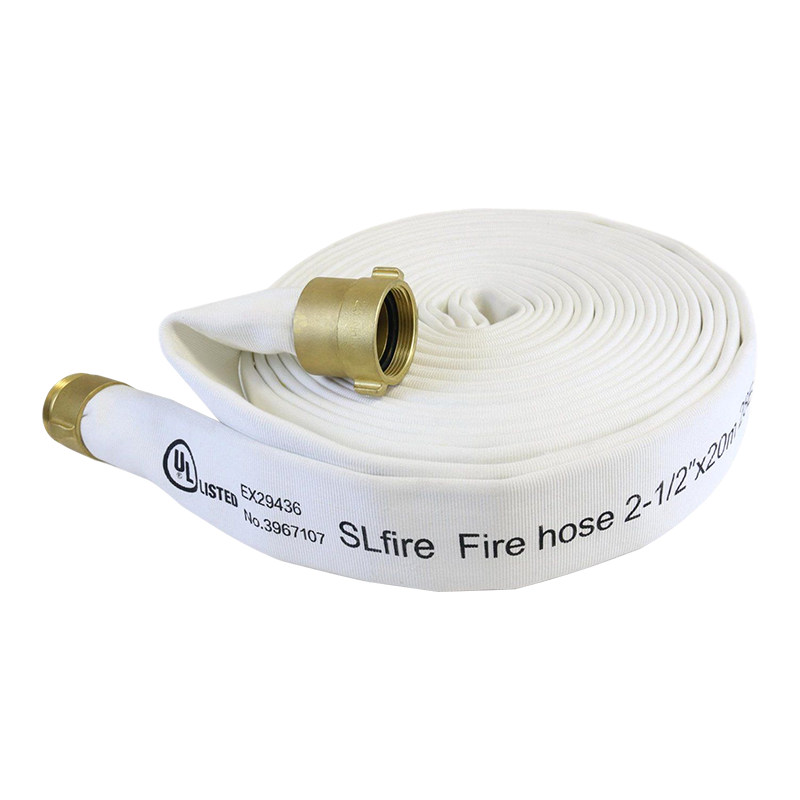
Single jacket, EPDM rubber liner Features • 100% high tenacity polyester jacket, high-grade EPDM rub...
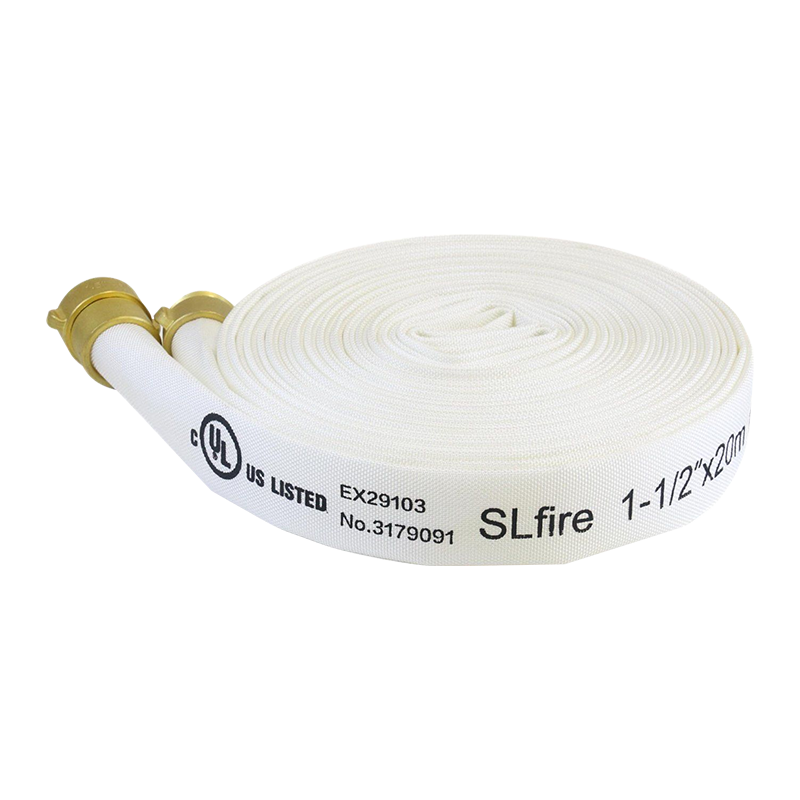
Single jacket, TPU liner •High-tenacity polyester yarn, circular woven in twill weave/plain weave,T ...
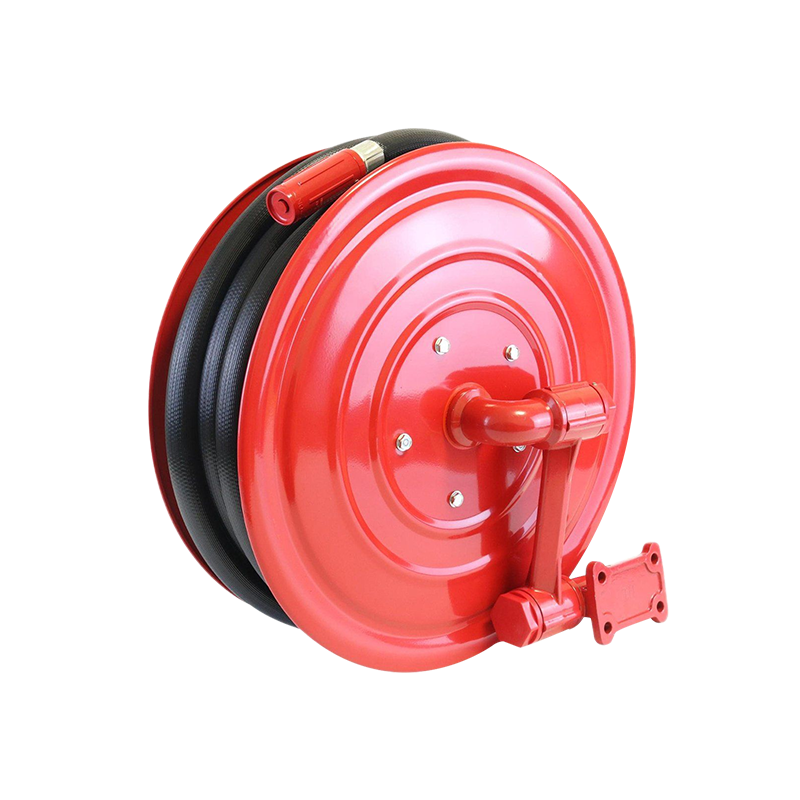
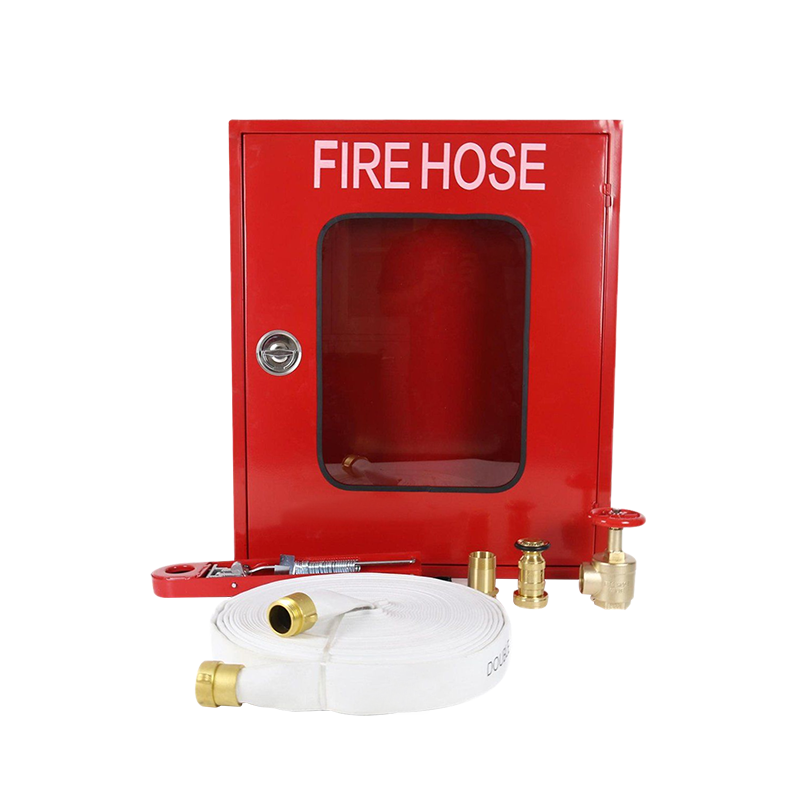
Fire cabinets are designed to accommodate fire hose,valve and other firefighting equipment. Type 201...
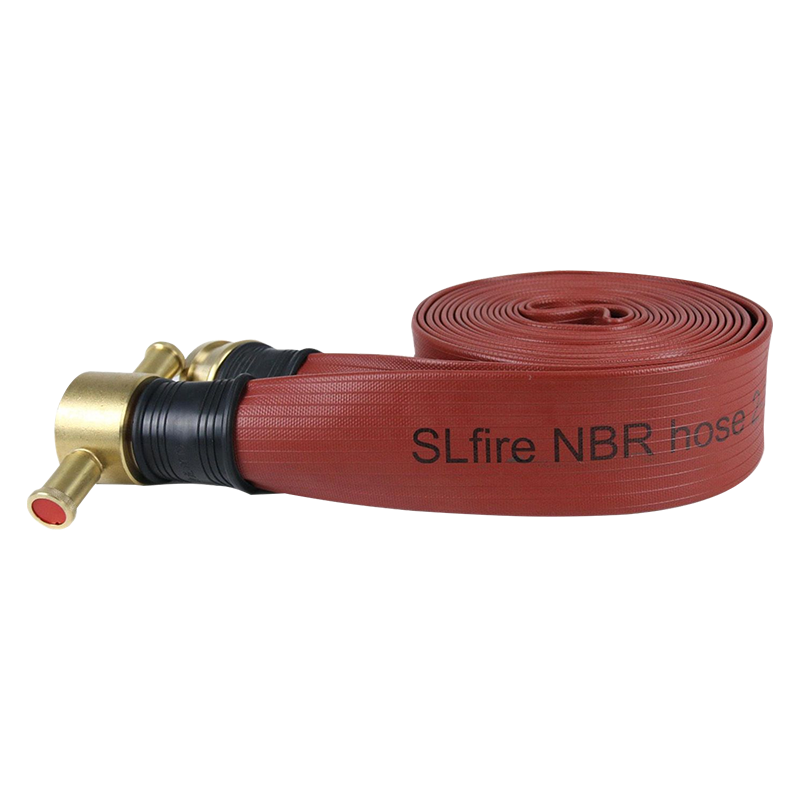
Nitrile covered hose •Nitrile/TPR blend as cover and lining, with 100% high-tenacity polyester yarn ...
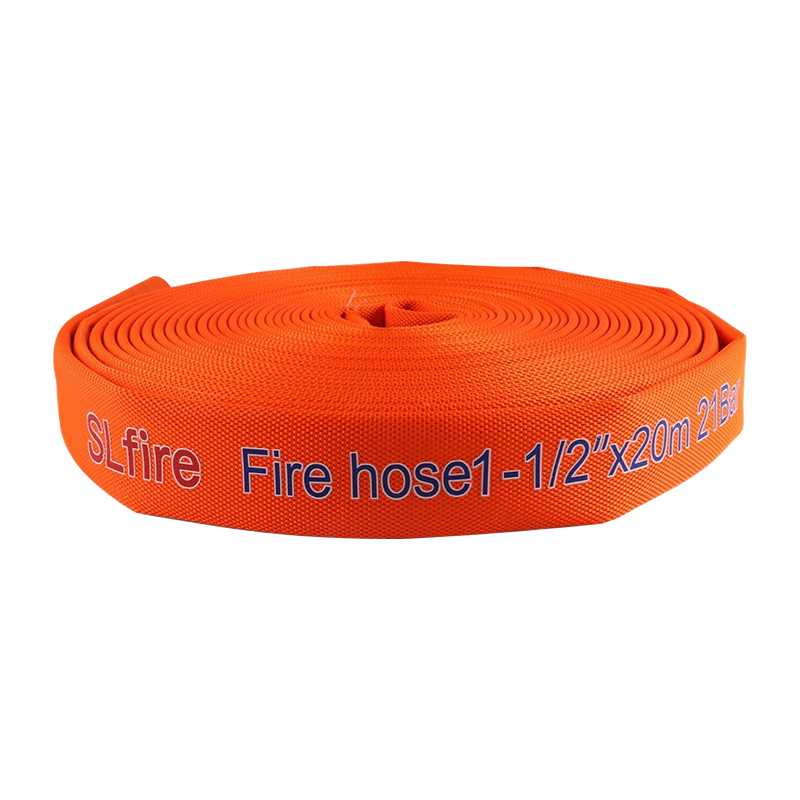
Single jacket, TPU liner •High-tenacity polyester yarn, circular woven in twill weave, TPU lining, f...
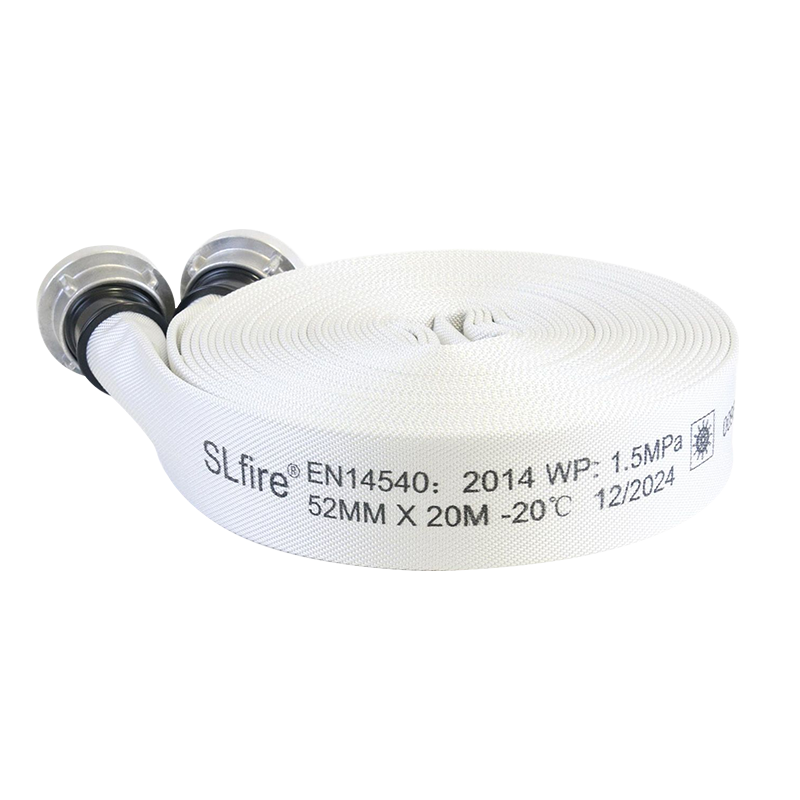
Marine hose Single jacket, PVC liner •100% high tenacity polyester yarn, circular woven in twill wea...
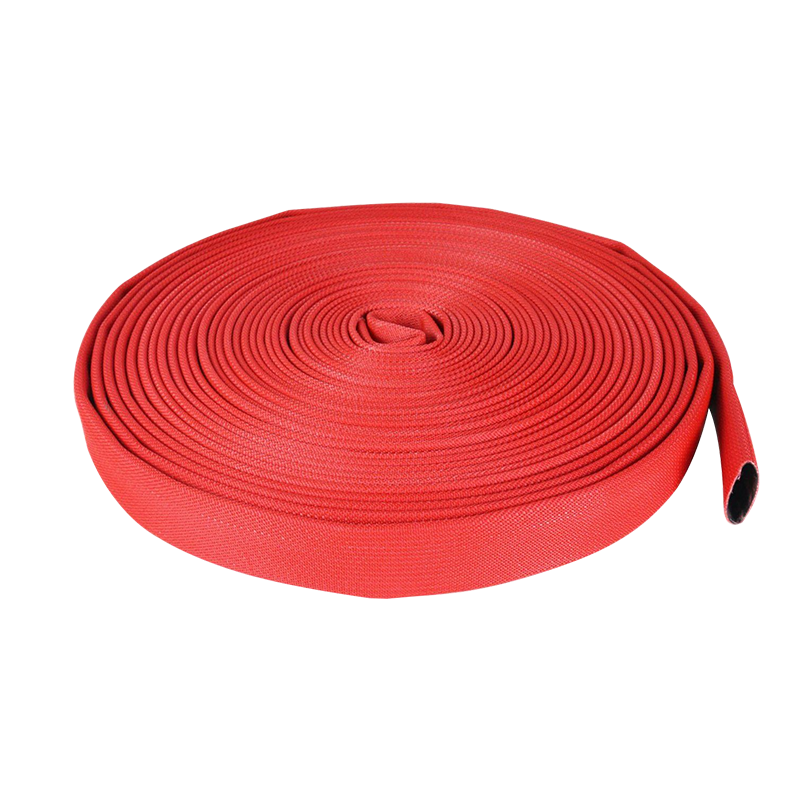
Marine hose Single jacket, PVC liner, PU coated •100% high tenacity polyester yarn,c ircular woven i...
 Call Us
+86 159-5116-9511
Need Support
Head Office
No.58, Kechuang Road, Sixiang Street Medicine Gaoxin District Taizhou City, Jiangsu Province

What Is a Fire Hose? A fire hose is a high-pressure flexible hose designed to carry water or fire retardant chemicals from a water source, such as a hydrant, pump, or tank, to a fire for suppression p...
Copyright © Taizhou Shenlong Fire Science and Technology Co., Ltd. All Rights Reserved.
 Fire Hose Manufacturers, Fire Hydrant Hose Factory