

 English
 русский
 Español
 Deutsch
 عربى
 Français
 Português
Don't hesitate to send a message

Single jacket, EPDM rubber liner Features • 100% high tenacity polyester jacket, high-grade EPDM rub...
Content
Liquid manure handling requires equipment that can move large volumes efficiently while tolerating demanding outdoor conditions. Hoses used in agricultural slurry and manure transfer are exposed to pressure, abrasion, ultraviolet radiation, oils, ozone, changing temperatures, rough ground, repeated folding, and constant movement across fields. A hose that is too rigid, too heavy, poorly bonded, or insufficiently reinforced can slow down operations and create costly maintenance problems.
The TPU layflat hose manure dray hose is designed for high-performance liquid manure applications where flexibility, pressure capability, durability, and practical handling are essential. Its construction combines a high-strength polyester filament reinforcement with thermoplastic polyurethane, commonly abbreviated as TPU, for both the cover and lining. The material layers are produced through a through-the-weave process that promotes strong integration between the reinforcement and TPU structure.
This design provides a flexible, collapsible hose that can be rolled for storage and transportation while remaining suitable for demanding agricultural pumping duties. It is available in several internal diameters, including 3, 4, 5, 6, and 8 inches, with standard lengths of 100 meters and 200 meters. Custom lengths can also be considered according to project and customer requirements.
Manufactured by Taizhou Shenlong Fire Science and Technology Co., Ltd., the hose benefits from the company’s long experience in coated and lined hose production. Since its establishment in 1995, the company has developed capabilities covering research and development, manufacturing, sales, and service. Although its product range is widely associated with fire hoses, its material and production expertise also supports industrial, agricultural, and customized hose applications.
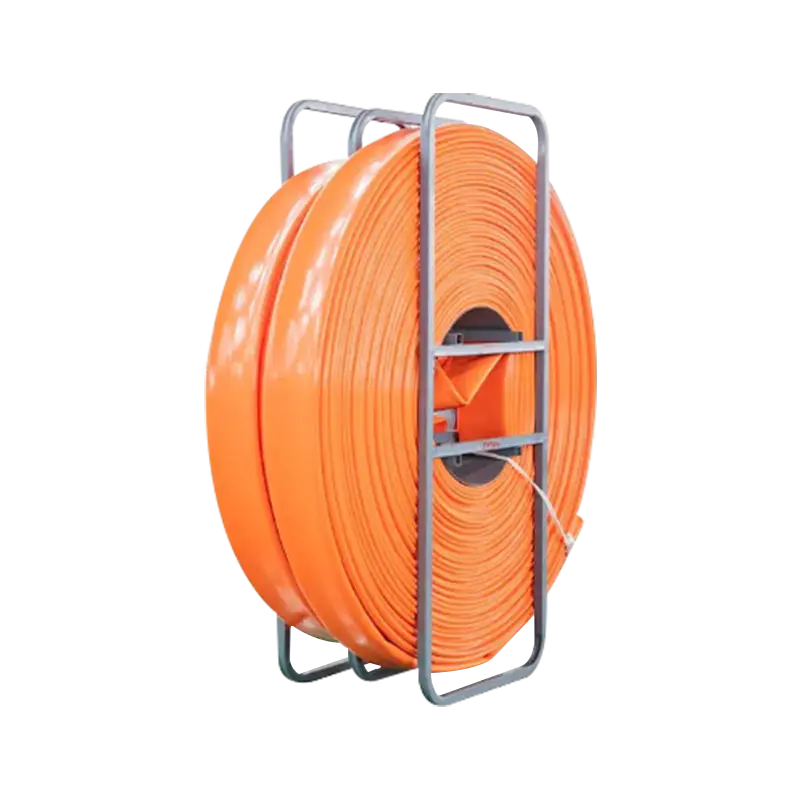
TPU Layflat Hose Manure Dray Hose
A manure dray hose is a flexible transfer hose used to move liquid manure, slurry, and related agricultural fluids between storage tanks, pumping systems, applicators, irrigation equipment, and field distribution points. “Layflat” describes the hose’s ability to flatten when not pressurized. This makes it significantly easier to coil, transport, deploy, and store than many conventional rigid or semi-rigid hose designs.
The TPU layflat manure dray hose uses a textile reinforcement embedded within a thermoplastic polyurethane body. The reinforcement provides pressure resistance and dimensional stability, while the TPU cover and lining provide a continuous fluid-contact surface and external protection. Together, these layers create a product that combines the flexibility of a fabric-reinforced hose with the wear resistance and chemical durability of polyurethane-based materials.
The hose is intended for heavy-duty agricultural use. It can be connected to manure pumps, tankers, dragline systems, field applicators, and other transfer equipment, provided that the operating pressure, temperature, connection method, and fluid compatibility are suitable for the specific installation.
Unlike ordinary lightweight water hoses, this product is engineered for applications where the hose may be pulled over soil, exposed to sunlight, repeatedly folded, and subjected to pressure fluctuations. Its construction is therefore focused not only on fluid transfer but also on service life, handling efficiency, and resistance to the environmental stresses found in agricultural operations.
The internal reinforcement is made from high-strength polyester filament. Polyester is widely used in pressure hose construction because it offers a useful balance of tensile strength, flexibility, fatigue resistance, and dimensional stability. The woven reinforcement absorbs the forces generated when the hose is pressurized and helps prevent excessive expansion.
For manure transfer, reinforcement strength is particularly important. Long hose runs can create substantial pulling forces during deployment and recovery. A hose may also be dragged across uneven ground or experience movement as agricultural machinery changes position. The polyester filament layer helps the hose resist these mechanical stresses while maintaining a flexible profile.
The textile structure also allows the hose to remain collapsible. This is a major practical advantage over rigid pipe because the hose can be rolled into a compact package after use. Reduced bulk can simplify transportation between fields and improve storage efficiency in farm buildings, equipment yards, and service vehicles.
TPU is used for both the external cover and internal lining. The lining provides the fluid-contact surface, while the cover protects the reinforcement from abrasion, moisture, ultraviolet exposure, and general environmental wear. Using TPU in both areas supports consistent material performance throughout the hose structure.
Thermoplastic polyurethane is recognized for its combination of elasticity, toughness, abrasion resistance, and resistance to weathering. These properties are valuable in manure transfer because the hose can encounter rough soil, stones, equipment edges, mud, fertilizer residues, oils, and outdoor exposure.
The TPU lining also creates a relatively smooth internal passage compared with many coarse textile or rubber constructions. A smooth passage can help reduce unnecessary flow resistance and simplify flushing after use. Actual flow performance depends on hose diameter, pump characteristics, fluid solids content, installation length, fittings, elevation changes, and operating pressure.
The hose is produced through a through-the-weave process. In this construction method, the TPU material is integrated through the reinforcement structure rather than simply being treated as a loosely attached outer coating. The process is intended to promote strong contact between the TPU layers and the woven polyester reinforcement.
Strong adhesion between layers is important because delamination can reduce pressure capability and shorten service life. When a hose is repeatedly bent, flattened, pressurized, and dragged, the cover, reinforcement, and lining must work together. A well-integrated structure helps distribute stress more evenly and reduces the likelihood that the layers will separate during normal service.
The combination of weaving and TPU integration gives the hose a balanced construction. The reinforcement carries tensile and pressure loads, while the TPU protects the reinforcement and provides the fluid barrier. This division of function is one reason textile-reinforced layflat hoses are widely used where both flexibility and high pressure resistance are required.
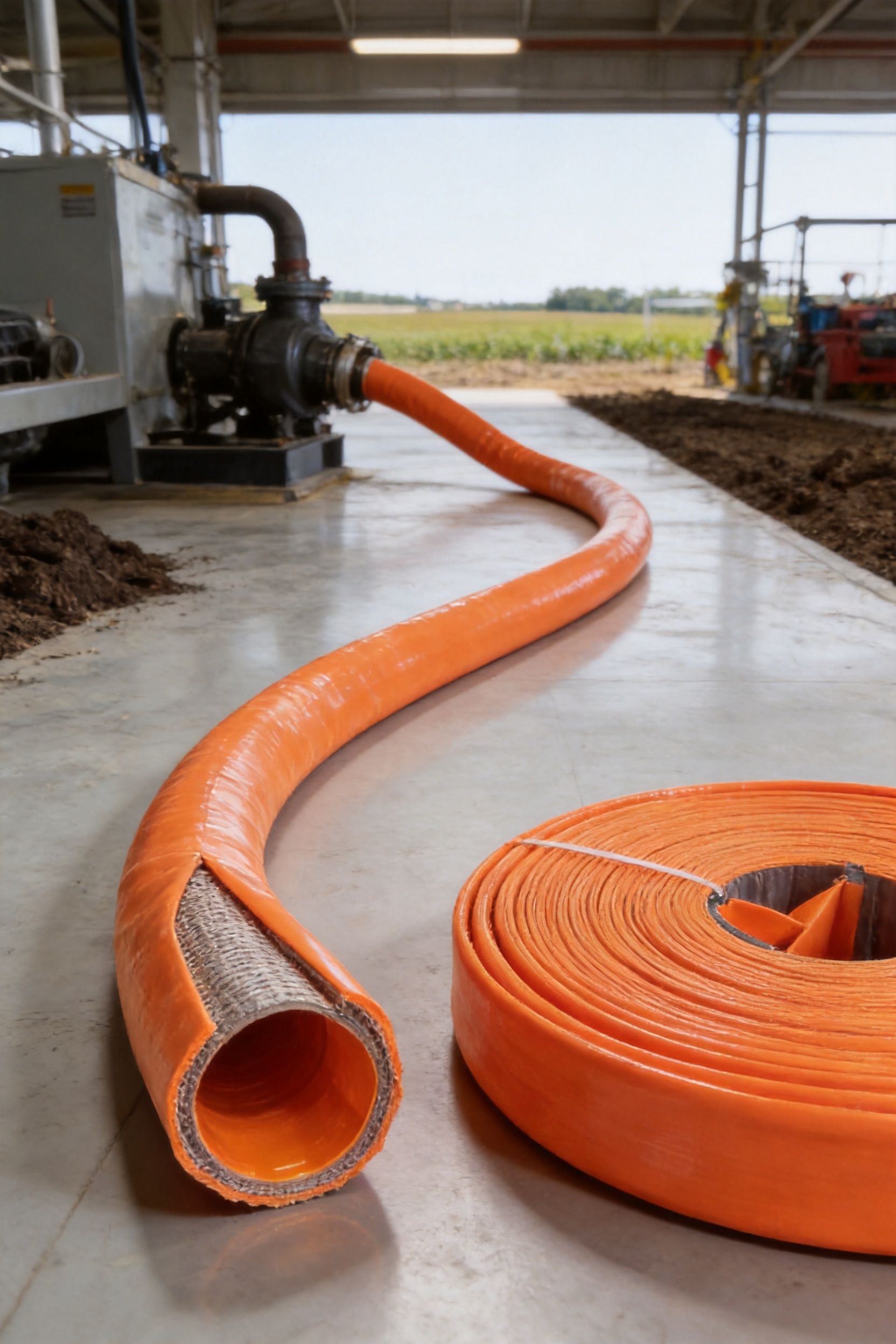
A manure transfer hose must withstand more than internal pressure. It may be pulled across fields, moved around pumps, lifted over obstacles, and subjected to tension when equipment changes position. High tensile strength helps the hose tolerate these forces and reduces the risk of premature stretching or structural damage.
The polyester filament reinforcement provides the primary mechanical support. When properly selected, installed, and operated within its rated limits, the hose can handle demanding agricultural layouts while remaining flexible enough for practical field use.
Strong adhesion is a central benefit of the through-the-weave TPU construction. A hose with weak bonding may develop blisters, separation, or localized deformation after repeated pressure cycles. These defects can compromise the hose and make inspection more difficult.
The integrated structure is designed to reduce the risk of delamination. This supports long-term reliability in environments where the hose may be repeatedly rolled, unrolled, folded, pressurized, depressurized, and exposed to moisture. Strong bonding also helps the hose maintain its intended shape and pressure performance over time.
Field conditions are rarely smooth. Hoses may cross compacted soil, gravel, crop residue, concrete, or equipment platforms. Abrasion can gradually wear through the outer layer and expose the reinforcement. Once the reinforcement is damaged, pressure resistance can be reduced.
TPU is selected for its resistance to abrasive wear. The protective cover helps the hose withstand contact with rough surfaces during normal handling and deployment. Nevertheless, operators should avoid unnecessary dragging over sharp edges, puncturing the hose with agricultural tools, or pulling it across surfaces that could cause concentrated damage.
Outdoor agricultural equipment is exposed to sunlight, rain, humidity, wind, dust, and changing temperatures. Ultraviolet radiation can degrade some polymer materials over time, causing cracking, loss of flexibility, and surface deterioration.
The TPU material used in this hose is resistant to UV exposure and weathering. This is beneficial for farms where hose assemblies may remain outdoors during a work cycle or be transported between locations. For maximum service life, the hose should still be cleaned, dried where practical, and stored away from direct sunlight when it is not in use.
Manure transfer systems are often operated near tractors, pumps, tankers, engines, hydraulic equipment, and fuel storage areas. Incidental contact with oils and oily residues may occur. The hose’s resistance to oil helps reduce the risk of rapid surface deterioration from ordinary agricultural operating conditions.
Ozone resistance is also useful because ozone can attack certain elastomeric materials, especially during long-term storage or outdoor exposure. TPU’s resistance to ozone supports more stable performance in changing environments.
The specified temperature range is from -40°F to 165°F, equivalent to approximately -40°C to +74°C. This range allows the hose to be used in cold climates and during warm-weather field operations, provided the actual fluid and system conditions remain within the specified limits.
Temperature affects flexibility, pressure behavior, and material performance. At low temperatures, operators should avoid sharp bends and sudden impact. At high temperatures, pressure ratings and fluid conditions should be reviewed carefully. The stated range should be treated as an operating guideline, and the hose should not be used beyond its approved temperature or pressure limits.
The hose is available in five common internal diameters. The smaller sizes are suitable where space, flow demand, or equipment connection dimensions favor a more compact hose. The larger sizes are intended for higher-volume transfer applications where reducing flow resistance and increasing throughput are priorities.
| Nominal Size | Internal Diameter | Working Pressure | Burst Pressure | Wall Thickness | Weight |
|---|---|---|---|---|---|
| 3 inches | 80 mm | 232 psi / 16 bar | 696 psi / 48 bar | 3.1 mm | 0.78 kg/m |
| 4 inches | 100 mm | 190 psi / 13 bar | 560 psi / 39 bar | 3.0 mm | 1.00 kg/m |
| 5 inches | 125 mm | 190 psi / 13 bar | 560 psi / 39 bar | 3.3 mm | 1.70 kg/m |
| 6 inches | 150 mm | 150 psi / 10 bar | 435 psi / 30 bar | 3.0 mm | 1.80 kg/m |
| 8 inches | 200 mm | 150 psi / 10 bar | 435 psi / 30 bar | 3.5 mm | 2.50 kg/m |
The working pressure is the maximum recommended pressure for normal operation under appropriate conditions. Burst pressure is a destructive-test value and must never be treated as an acceptable operating pressure. A suitable safety margin should always be maintained between normal system pressure and the hose’s working-pressure rating.
The 3-inch hose provides the highest listed working pressure and the lowest weight per meter. It may be appropriate for compact manure transfer systems or installations where portability is especially important. The 4-inch and 5-inch options offer a balance between flow capacity and manageable weight. The 6-inch and 8-inch versions support higher-volume movement while retaining the layflat advantages of flexible storage and deployment.
Size selection should consider pump output, required transfer distance, fluid viscosity, solids content, elevation changes, connection size, expected pressure surges, and the number of bends in the system. Choosing an unnecessarily small hose can increase friction loss and pump demand. Choosing an unnecessarily large hose can increase purchase cost, storage requirements, and handling weight. A system designer should evaluate the complete installation rather than selecting a hose by diameter alone.
Rigid pipe can provide reliable flow performance, but it requires more labor and equipment for installation, relocation, and storage. Pipe sections may need machinery to move them, and changing a field layout can involve additional fittings and support structures.
The TPU layflat hose offers greater flexibility. It can be rolled, transported, and deployed over changing terrain without the same level of permanent infrastructure. This is particularly useful for seasonal manure application, temporary transfer routes, rental equipment, and farms that move pumping systems between fields.
Basic PVC layflat hose can be economical for light-duty water transfer, but it may not provide the same combination of abrasion resistance, tensile strength, low-temperature flexibility, and layer adhesion required for intensive manure handling. The appropriate choice depends on the application, but TPU construction is generally positioned toward more demanding service conditions.
The through-the-weave construction and polyester reinforcement provide additional structural support. The TPU cover and lining are also designed for better resistance to abrasion, oil, UV exposure, ozone, and weathering than many entry-level hose materials.
Rubber hoses can offer flexibility and durability, but they may be heavier and more difficult to transport over long distances. A heavy hose increases manual handling demands and may require additional equipment for deployment and recovery.
The layflat design reduces storage volume when the hose is depressurized. The TPU construction can also provide a favorable strength-to-weight balance, especially in long agricultural runs where every additional kilogram affects handling efficiency.
Lightweight fabric hoses are easy to move but may be intended for lower-pressure or less abrasive services. The TPU manure dray hose is designed for higher-performance use, with listed working pressures ranging from 10 to 16 bar depending on diameter.
Its stronger reinforcement and integrated material structure make it better suited to repeated agricultural use than a hose selected only for low cost or minimal weight. The correct product should always be selected according to the actual duty cycle, pressure, fluid, and environment.
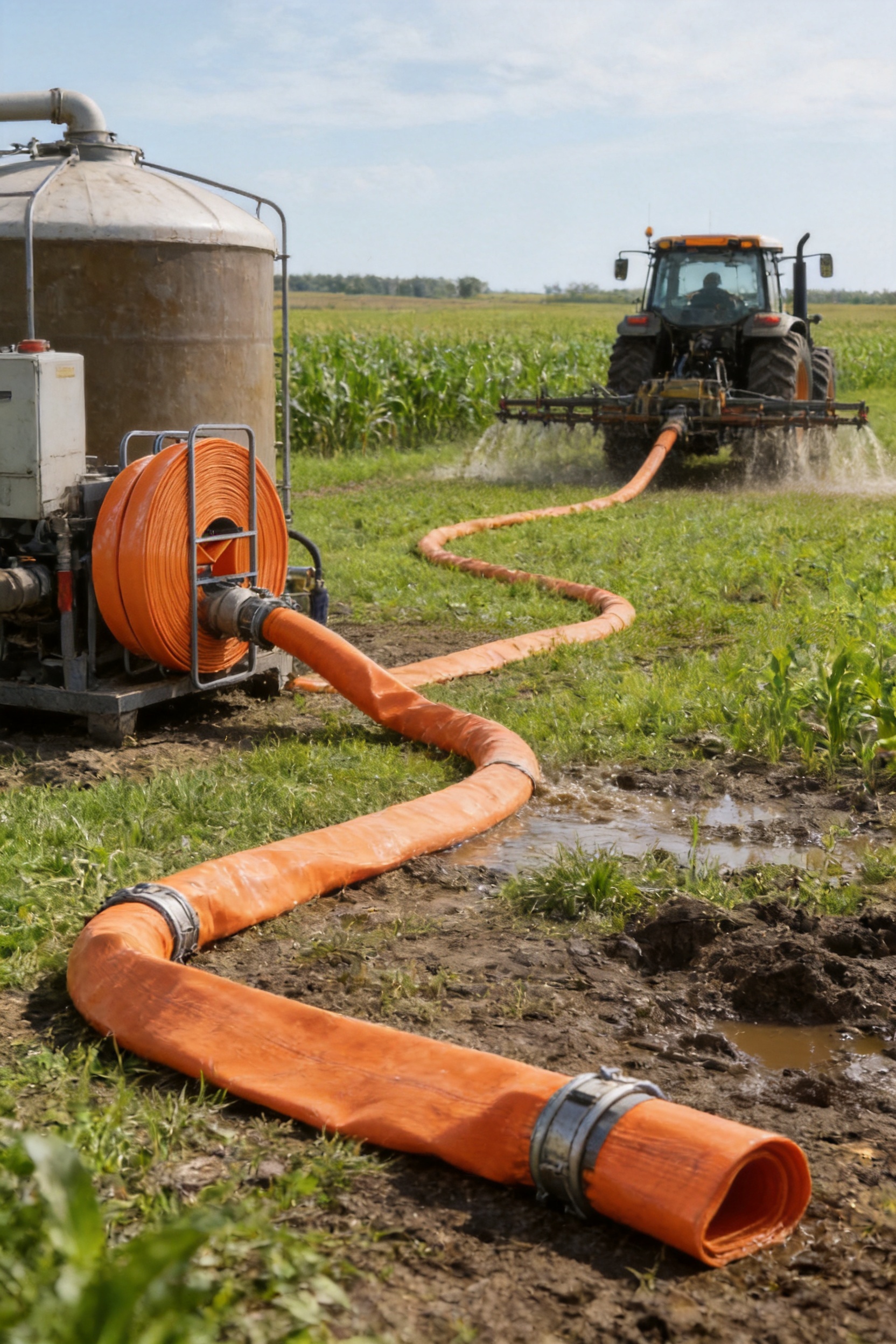
The primary application is the transfer of liquid manure from storage lagoons, tanks, pits, or collection systems to field application equipment. The hose can be used as part of a temporary or semi-permanent transfer line, subject to compatible couplings and operating conditions.
Dragline systems deliver liquid manure across fields while the application machinery moves along a designated path. Layflat hose is valuable in this type of operation because it can be deployed across large areas and repositioned as field sections are completed.
Its flexibility allows it to follow practical field routes while its collapsible design simplifies recovery. The hose should be routed carefully to avoid sharp turns, pinch points, vehicle traffic, and contact with cutting or cultivating equipment.
The hose can also be used for transfer between storage facilities and tankers or application vehicles. A flexible connection can make it easier to accommodate differences in equipment position and reduce the need for rigid alignment.
Although designed for liquid manure applications, TPU layflat hose may also be considered for other agricultural liquids when material compatibility has been confirmed. Potential uses can include process water, irrigation support, fertilizer solutions, and selected non-potable agricultural fluids.
Compatibility should not be assumed solely from the hose material. Fluid concentration, temperature, additives, cleaning chemicals, and exposure time can affect service life. Customers should provide complete fluid information when requesting suitability confirmation.
Taizhou Shenlong Fire Science and Technology Co., Ltd. was founded in 1995 and operates as an integrated research and development, production, sales, and service enterprise. This broad structure is valuable for customers seeking more than a standard catalog item because product requirements can be discussed with a manufacturer that understands material selection, reinforcement, coating, testing, and end-use performance.
The company’s main product background is in lined fire hoses made from various materials. Fire hose manufacturing requires close attention to pressure resistance, textile reinforcement, lining adhesion, dimensional consistency, and long-term durability. These same technical foundations are relevant to TPU agricultural hose production.
The company also undertakes foreign trade product production involving rubber, PVC, polyurethane, and double-sided tape products according to customer requirements. This material diversity supports a practical understanding of polymer processing and customer-specific manufacturing needs.
Its products are sold in more than 20 provinces, cities, and autonomous regions, while cooperation with domestic foreign trade companies supports export production for international markets. The company’s products are used in fire protection, construction, water conservancy, and other industries. Exposure to these sectors requires the ability to manufacture products for different operating environments, specifications, and customer expectations.
Research and development capabilities help a hose manufacturer adjust materials, reinforcement structures, dimensions, colors, lengths, and processing parameters. For agricultural customers, this can be important when standard products do not perfectly match the pump, field layout, or connection system.
Customer discussions may involve diameter, pressure rating, working temperature, roll length, color, coupling configuration, and application conditions. A manufacturer with in-house technical experience is better positioned to evaluate these requirements and recommend a practical configuration.
The company’s experience with lined hose products provides an established foundation for controlling the relationship between the textile reinforcement and polymer lining. The through-the-weave TPU process requires attention to material consistency, bonding, coverage, dimensions, and cooling or forming conditions.
Process control is especially important for layflat hose because the product must remain flexible without sacrificing pressure performance. Excessive stiffness can make field deployment difficult, while insufficient reinforcement or poor bonding can reduce reliability. A balanced manufacturing process helps maintain the intended relationship between flexibility, strength, and durability.
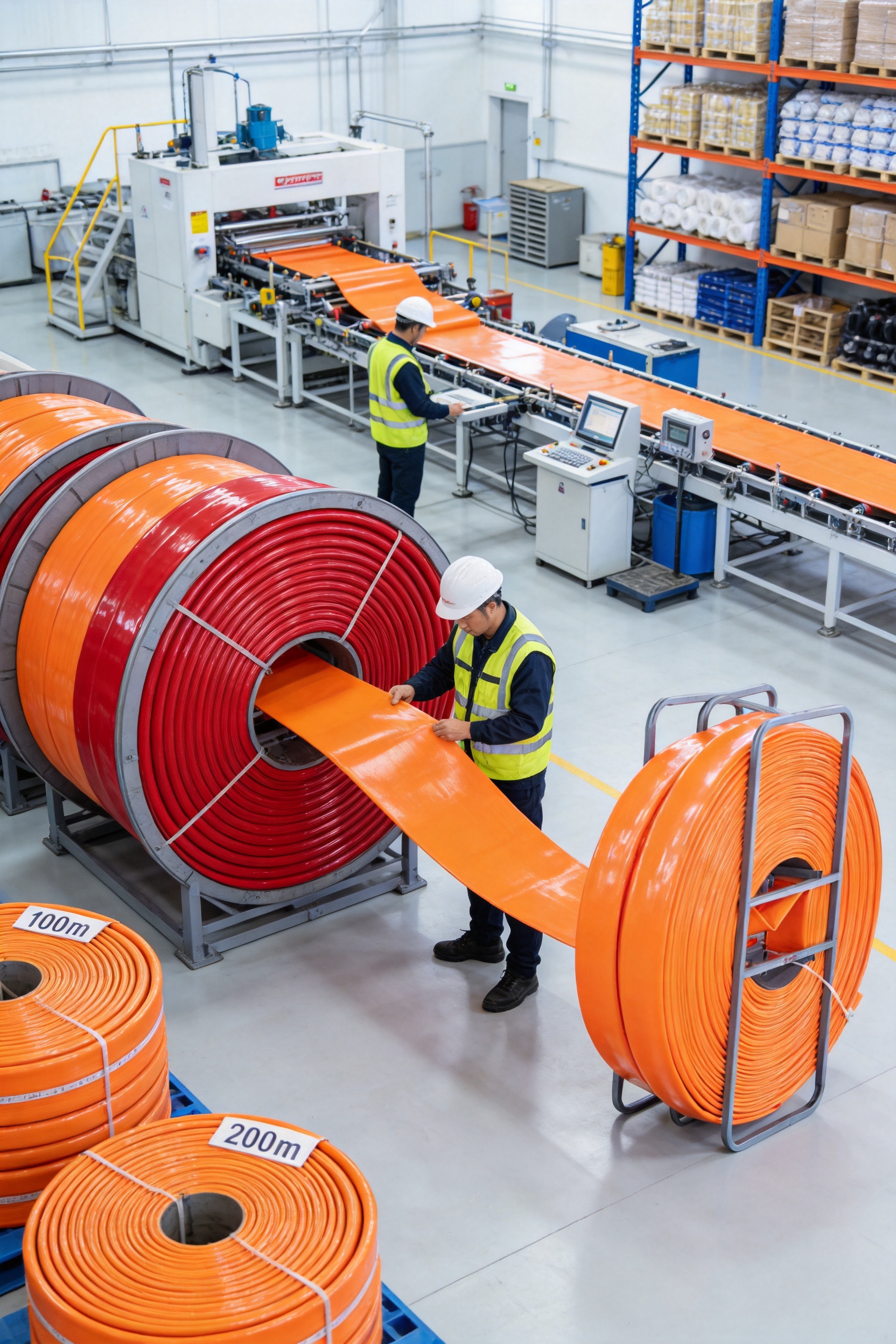
The hose is available in 100-meter and 200-meter lengths, with customer-requested lengths also possible. Custom length production can reduce the number of field joints, simplify layout planning, and better match transport or storage requirements.
Standard colors include red and orange, while other colors may be available upon request. Bright colors can improve visibility in outdoor work areas and make hose routes easier to identify. Custom color requirements may also support equipment coordination, product differentiation, or customer specifications.
Because the company combines manufacturing and sales service, customers can communicate product requirements, packaging expectations, documentation needs, and delivery arrangements through a coordinated supplier. This is useful for distributors, agricultural equipment companies, contractors, and international buyers requiring repeat orders.
Export-oriented production also requires attention to packaging, labeling, dimensions, product identification, and shipment preparation. These details can affect the efficiency of receiving, warehousing, and distribution after the hose leaves the factory.
Reliable hose performance begins with consistent raw materials. Polyester filament should meet the required strength and uniformity characteristics, while TPU must provide appropriate flexibility, abrasion resistance, adhesion, and temperature performance. Material inspection and controlled storage help reduce variation before production begins.
During weaving and extrusion or coating operations, manufacturers must control the position of the reinforcement, the thickness of the TPU layers, the width and circumference of the hose, and the bonding between components. Small deviations can affect the final pressure rating, weight, flexibility, and connection performance.
Finished hose inspection should include visual examination for cuts, blisters, exposed reinforcement, uneven coating, surface defects, and dimensional irregularities. Pressure testing and sample testing can help confirm that the product meets its specified performance requirements.
Packaging is also part of quality protection. The hose should be coiled or wound in a manner that avoids severe kinks and unnecessary deformation. Ends should be protected during transport, and rolls should be secured to prevent movement or impact damage.
Before installation, inspect the entire hose length for cuts, punctures, abrasion, exposed reinforcement, or signs of layer separation. Check that couplings, clamps, gaskets, and pump connections are suitable for the hose diameter and rated pressure.
Lay the hose along a route that minimizes sharp bends. A bend radius that is too tight can restrict flow and place excessive stress on the reinforcement. Avoid routing the hose over sharp stones, exposed metal, cutting edges, or areas where vehicles may run over it.
Ensure that the pump is started gradually. Sudden pressure surges can occur when a pump starts, a valve closes rapidly, or an obstruction is cleared. The working pressure rating should account for normal operating pressure as well as foreseeable pressure transients.
Do not use the burst pressure as an operating target. Burst pressure represents a destructive limit and does not account for aging, repeated pressure cycles, temperature, abrasion, fittings, or installation factors. Safe operation requires maintaining pressure below the listed working pressure and following the instructions of the system designer.
During operation, monitor the hose for unusual swelling, vibration, leakage, flattening, or movement. If a defect is observed, stop the pump safely, isolate the pressure, and inspect the affected section. Never approach or handle a pressurized hose that appears damaged.
After use, flush the hose when appropriate to remove manure residue and suspended solids. Cleaning can reduce odor, blockage, and internal buildup. Use cleaning procedures and chemicals that are compatible with TPU. Avoid harsh chemicals unless compatibility has been confirmed by the manufacturer or a qualified technical specialist.
Before storage, drain the hose and allow external moisture to evaporate where practical. Remove mud, manure, fertilizer residues, and other contaminants from the outer surface. Contaminants left on the hose can make inspection difficult and may accelerate surface deterioration.
Coil the hose without twisting it. Avoid tight bends, sharp folds, and heavy objects placed on top of the coil. Store the hose in a cool, dry, and ventilated location away from direct sunlight, excessive heat, sparks, solvents, fuels, and sharp equipment.
Although the TPU material is resistant to UV, oil, ozone, and weathering, protected storage can extend service life. Long-term outdoor storage should be avoided whenever an indoor or shaded alternative is available.
Establish an inspection schedule based on operating frequency. A hose used daily in abrasive field conditions should be inspected more often than a hose used occasionally. Record the date of inspection, operating location, observed defects, repairs, and replacement sections.
Hose sections with severe cuts, exposed reinforcement, significant abrasion, leakage, bulges, or delamination should be removed from service. Temporary repairs may not restore the original pressure rating and should not be used as a substitute for proper replacement or manufacturer-approved repair procedures.
When requesting a quotation, provide the intended fluid, operating pressure, pump type, transfer distance, required diameter, temperature range, expected length, connection standard, and working environment. This information helps the supplier evaluate whether the standard configuration is suitable.
Customers should also clarify whether the hose will be used in a temporary dragline system, a fixed transfer route, tanker loading operation, irrigation support application, or another configuration. The same nominal diameter can perform differently depending on pressure loss, elevation, pump capacity, and the number of fittings.
For distributors, the 100-meter and 200-meter standard lengths can simplify inventory planning. Custom lengths may be more suitable for project orders or equipment manufacturers that need a specific roll size. Red and orange are standard color options, while custom colors may be discussed for private-label or system-identification requirements.
It is also important to confirm packaging dimensions, roll weight, labeling, inspection documentation, and delivery requirements before placing a large order. These factors influence transportation cost, warehouse handling, and customer fulfillment.
Modern agricultural operations increasingly focus on labor efficiency, nutrient management, environmental control, and equipment utilization. A manure hose is not merely a fluid conduit; it is part of a larger system that affects pumping time, field mobility, storage organization, and maintenance workload.
The TPU layflat design supports efficient deployment and recovery. Its polyester reinforcement provides strength, while the TPU material contributes resistance to abrasion, UV radiation, oil, ozone, and weathering. Strong adhesion between layers helps maintain structural integrity through repeated use.
The available diameters allow the hose to be matched to different flow requirements. The temperature range supports operation across diverse climates, and the available 100-meter and 200-meter lengths provide flexibility for short and extended transfer routes.
Compared with heavier rigid systems or lower-duty flexible hoses, the product offers a balanced solution for agricultural users who need portability, pressure capability, and durability in one hose construction. Correct system design and responsible maintenance remain essential, but the underlying material and manufacturing approach provide a strong foundation for long-term service.
The hose is designed primarily for transferring liquid manure and slurry in agricultural pumping and field application systems. It may also be considered for other agricultural liquids after material compatibility and operating conditions have been reviewed.
It is called layflat because it collapses into a flattened profile when it is not pressurized. This makes the hose easier to roll, transport, store, and deploy than a rigid pipe or non-collapsible hose.
The hose uses high-strength polyester filament as reinforcement and TPU as the cover and lining. The components are integrated through a through-the-weave process intended to provide strong adhesion and durable performance.
The listed internal diameters are 3, 4, 5, 6, and 8 inches, corresponding approximately to 80, 100, 125, 150, and 200 millimeters.
The listed working pressure ranges from 150 psi to 232 psi, or approximately 10 to 16 bar, depending on the hose diameter. The 3-inch model is listed at 232 psi or 16 bar, the 4-inch and 5-inch models at 190 psi or 13 bar, and the 6-inch and 8-inch models at 150 psi or 10 bar.
No. Burst pressure is a destructive limit and must never be treated as a normal operating pressure. The system should operate below the specified working pressure, with an appropriate safety margin for pressure surges and service conditions.
Standard lengths include 100 meters and 200 meters. Custom lengths can be considered according to customer requirements and production arrangements.
Red and orange are standard colors. Other colors may be available upon customer request, subject to production and order requirements.
The TPU material is resistant to abrasion, ultraviolet radiation, oil, ozone, and weathering. Proper cleaning, inspection, and protected storage are still recommended to maximize service life.
The specified temperature range is -40°F to 165°F, or approximately -40°C to +74°C. Operators should still avoid impact, sharp bending, and sudden pressure application when the hose is very cold.
Drain and clean the hose, coil it without twisting, and store it in a cool, dry, ventilated place away from direct sunlight, heat, solvents, fuels, and sharp objects. Avoid placing heavy equipment on the coil.
Its high-strength polyester reinforcement, TPU cover and lining, through-the-weave construction, strong layer adhesion, listed pressure capability, and resistance to abrasion and weathering make it suitable for more demanding agricultural transfer work than many lightweight hoses.
The hose is manufactured by Taizhou Shenlong Fire Science and Technology Co., Ltd., a company founded in 1995 with experience in research and development, production, sales, and service for lined and coated hose products.
The product information indicates that custom lengths and customer-requested colors can be considered. Customers should provide detailed requirements, including diameter, pressure, fluid, length, connection, color, and packaging expectations, for confirmation.
The TPU layflat hose manure dray hose is engineered for agricultural users who need a flexible, durable, and pressure-capable solution for liquid manure transfer. Its high-strength polyester reinforcement supports tensile and pressure performance, while the TPU cover and lining provide resistance to abrasion, UV radiation, oil, ozone, and weathering.
The through-the-weave process and strong adhesion between layers are central to the product’s durability. These features help the hose withstand repeated handling, folding, pressurization, and outdoor exposure. With sizes from 3 to 8 inches, working pressures up to 232 psi, standard lengths of 100 and 200 meters, and custom production options, the hose can be adapted to a broad range of farm and agricultural equipment requirements.
Backed by Taizhou Shenlong Fire Science and Technology Co., Ltd.’s experience since 1995, the product reflects a manufacturing approach based on textile reinforcement, polymer processing, lined hose technology, customized production, and integrated customer service. When correctly sized, installed, inspected, and maintained, it can contribute to more efficient manure handling, easier field deployment, and improved equipment reliability.
1. Manufacturer-provided technical information for TPU Layflat Hose Manure Dray Hose.
2. Manufacturer-provided product specifications for hose diameter, pressure rating, wall thickness, and weight.
3. Manufacturer-provided company information concerning research and development, production, sales, and service capabilities.
4. General principles of textile-reinforced thermoplastic hose construction and polymer-lined fluid transfer hose design.
5. General agricultural equipment practices for liquid manure pumping, dragline application, hose handling, inspection, and storage.
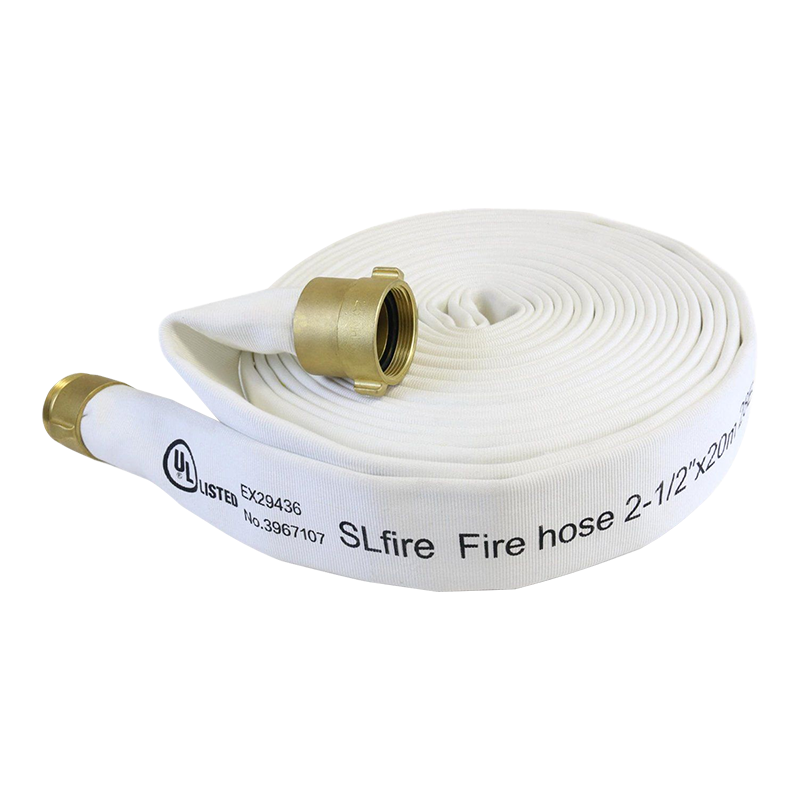
Single jacket, EPDM rubber liner Features • 100% high tenacity polyester jacket, high-grade EPDM rub...
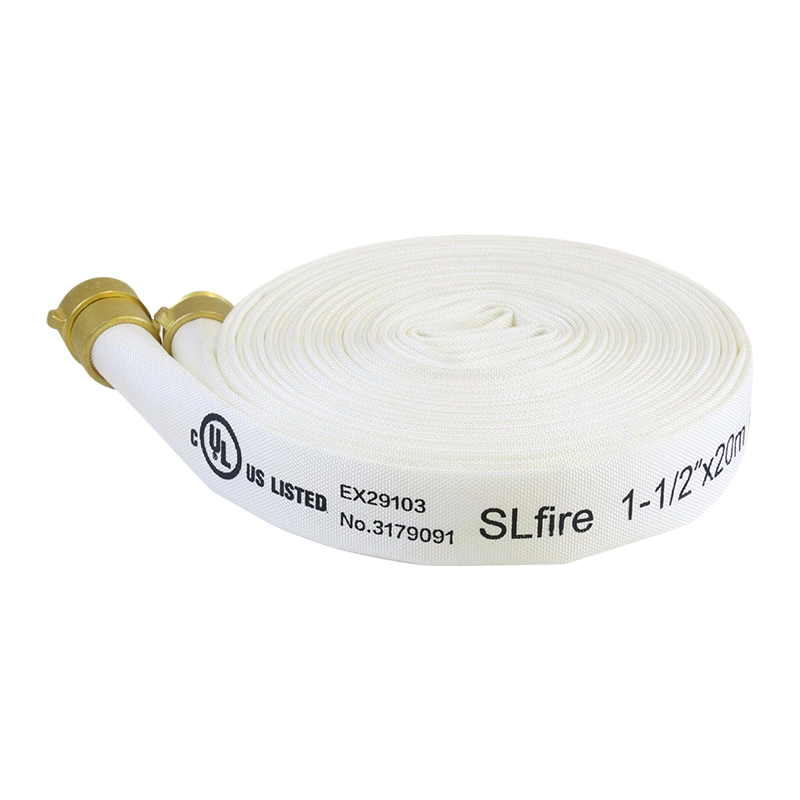
Single jacket, TPU liner •High-tenacity polyester yarn, circular woven in twill weave/plain weave,T ...
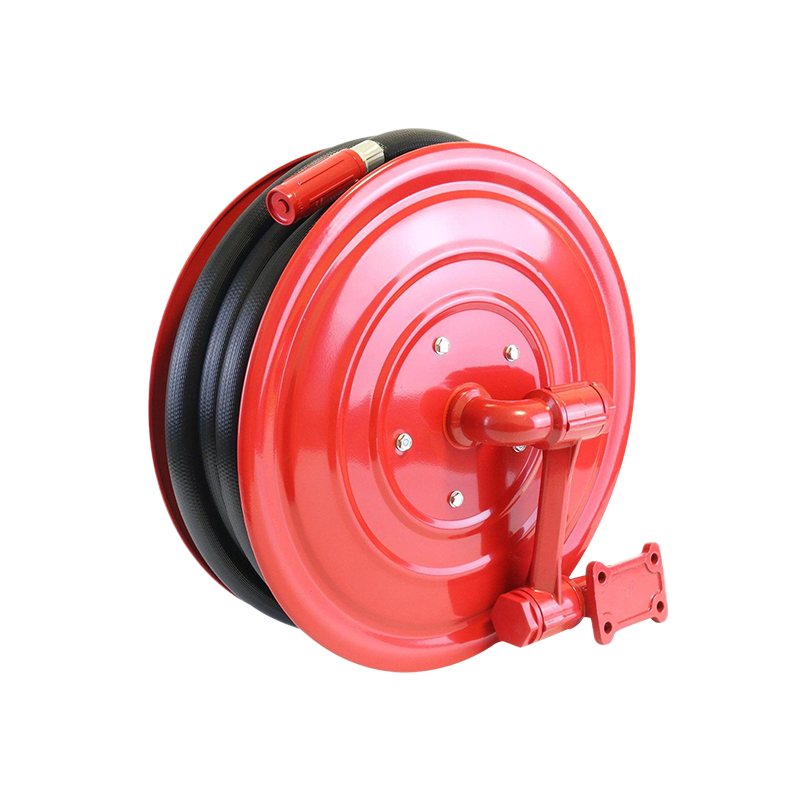
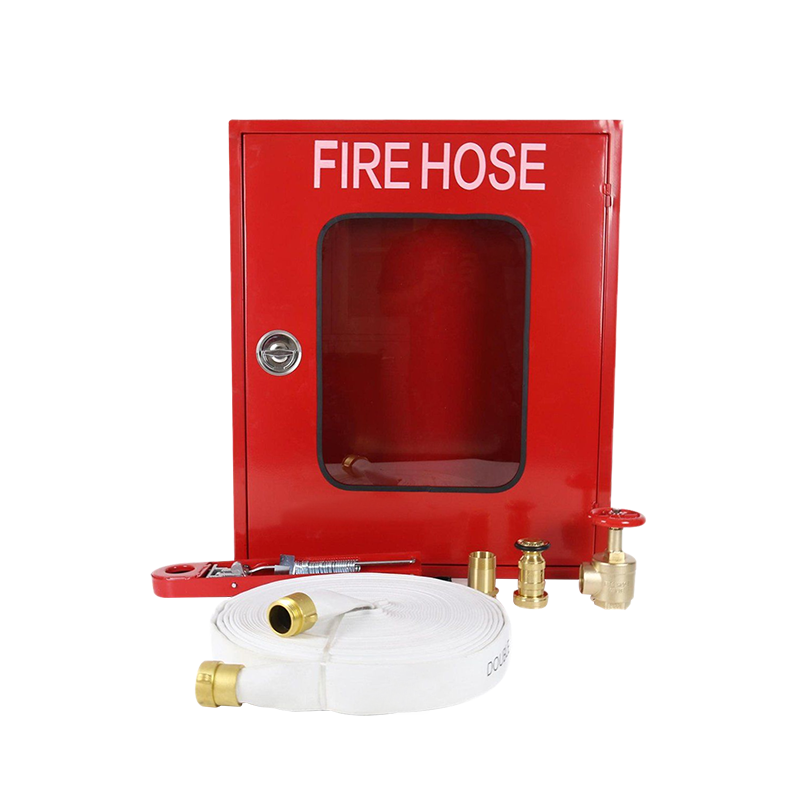
Fire cabinets are designed to accommodate fire hose,valve and other firefighting equipment. Type 201...
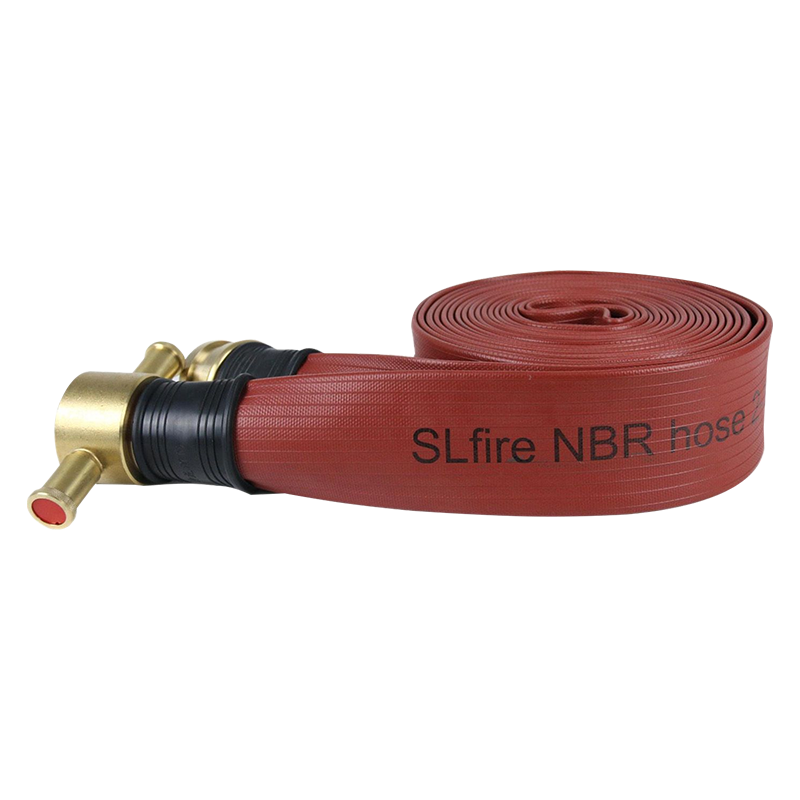
Nitrile covered hose •Nitrile/TPR blend as cover and lining, with 100% high-tenacity polyester yarn ...
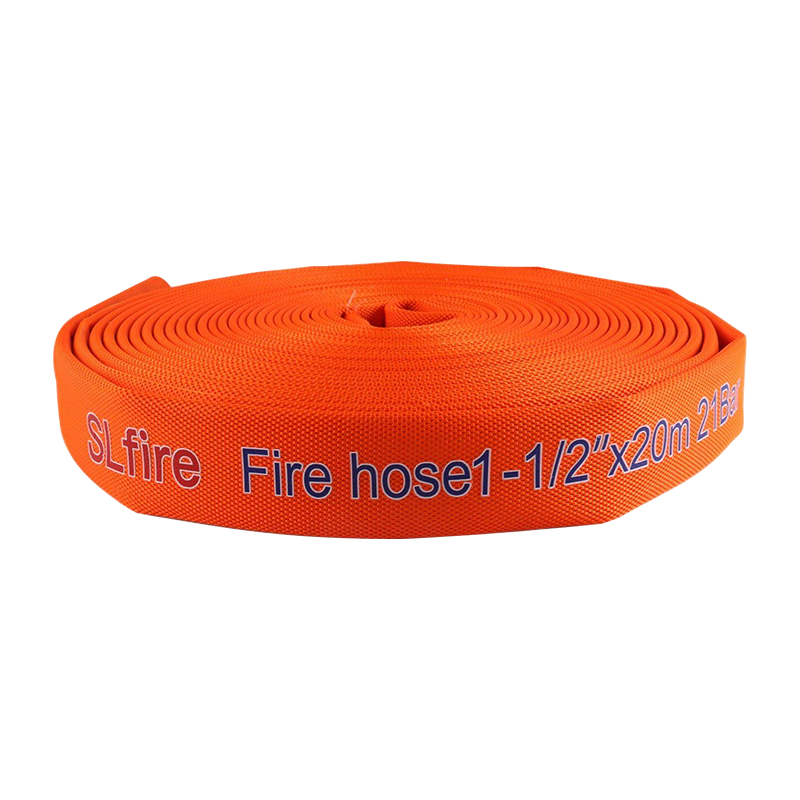
Single jacket, TPU liner •High-tenacity polyester yarn, circular woven in twill weave, TPU lining, f...
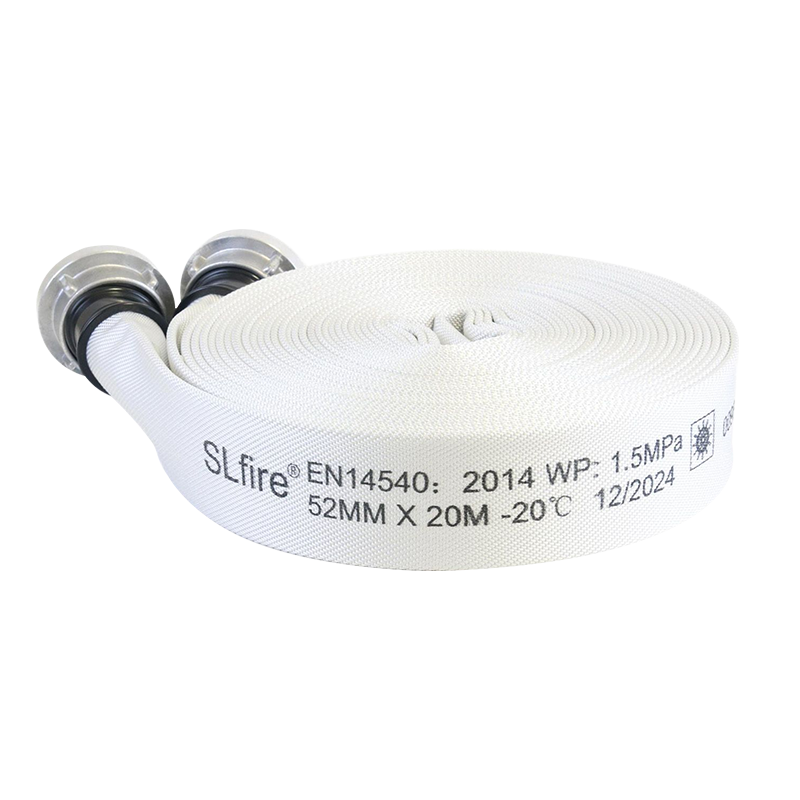
Marine hose Single jacket, PVC liner •100% high tenacity polyester yarn, circular woven in twill wea...
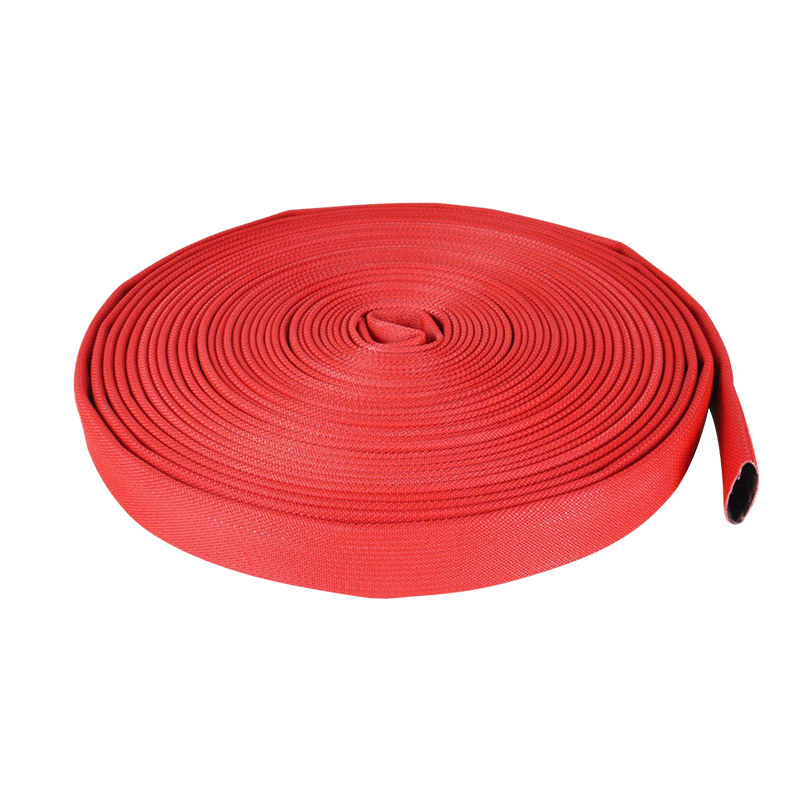
Marine hose Single jacket, PVC liner, PU coated •100% high tenacity polyester yarn,c ircular woven i...
 Call Us
+86 159-5116-9511
Need Support
Head Office
No.58, Kechuang Road, Sixiang Street Medicine Gaoxin District Taizhou City, Jiangsu Province

At a structure fire, the first line off the truck is the one that does the hardest work. Pulled around obstacles, dragged across gravel, charged with high-pressure water, and shut off at the nozzle d...
Copyright © Taizhou Shenlong Fire Science and Technology Co., Ltd. All Rights Reserved.
 Fire Hose Manufacturers, Fire Hydrant Hose Factory